

If you’ve ever noticed thick ridges of ice along your roof edge—or long icicles hanging from gutters—you may be dealing with an ice dam. Ice dams are one of the most common winter roofing problems in Rhode Island and across New England, and they can lead to interior leaks, stained ceilings, damaged insulation, and ruined drywall.
Below is a clear breakdown of what ice dams are, how they form, how they cause leaks, and the first step that stops most active leaks: removing the snow and only the safe-to-remove ice—without damaging your roof or gutters.
An ice dam is a buildup of ice that forms along the lower edge of a roof (usually near the eaves and gutters). As it grows, it can trap melting snow behind it. That trapped water has nowhere to go, so it can back up underneath shingles and into your home.
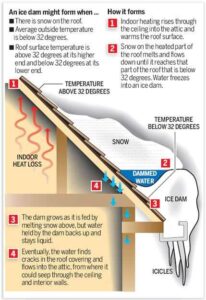
Ice dams form when part of your roof is warm enough to melt snow, while the roof edge stays cold and refreezes that meltwater.
Here’s the typical chain reaction:
Snow piles up on your roof after a storm.
Heat from inside the home (often from the attic) warms the upper roof, melting the bottom layer of snow.
That meltwater runs downward toward the roof edge.
The roof edge/eaves are colder (they extend beyond the heated part of the house), so the water refreezes.
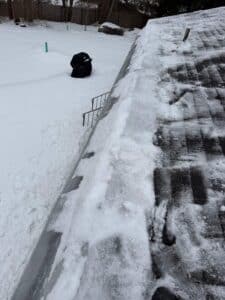
Over time, the refrozen water builds into a thick ridge of ice—the ice dam.
New meltwater gets trapped behind it and backs up under shingles.
Roof shingles are designed to shed water flowing downhill. They are not designed to hold back water that’s pushing upward behind an ice dam.
Once water pools behind that ice ridge, it can:
Work its way under shingles
Slip into tiny openings around nails, seams, and flashing
Soak roof decking and insulation
Travel along framing and show up as a leak far from where it entered
That’s why an ice-dam leak might appear as:
A ceiling stain in a bedroom
Dripping near a window or exterior wall
Wet insulation in the attic
Water marks that “move” after each thaw/freeze cycle
When a leak is actively happening in winter, the fastest, most effective first move is:
This does two things immediately:
Reduces melting water feeding the dam
Creates a path for water to drain instead of backing up under shingles
In many cases, once the lower roof area is cleared and drainage is restored, the active leaking stops.
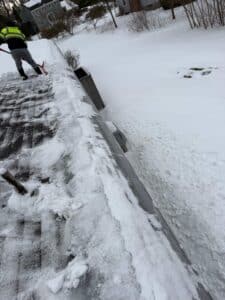
The safest homeowner step is using a roof rake (standing on the ground) to remove snow from the lower 3–6 feet of roof above the gutters/eaves.
Focus on the roof edge, valleys, and areas above problem spots.
Clearing that lower section often reduces or stops the leak by limiting runoff behind the dam.
If icicles are small/loose and can be removed from the ground without pulling on the gutter, they can be taken down carefully.
Important: icicles are heavy. Keep people clear of the drop zone.
A common professional-safe approach is to use calcium chloride (not rock salt) in a permeable sleeve/sock to create a small drainage channel through the ice so meltwater can escape.
This helps water drain off the roof instead of backing up.
It avoids aggressive chipping that damages shingles and gutters.
Chipping ice with a shovel, hatchet, or hammer frequently:
Breaks shingle edges
Damages underlayment
Dents or loosens gutters
Pulls fasteners out
Creates new leak points that last beyond winter
Rock salt can corrode metal, damage gutters, and deteriorate roofing components.
Falls are the biggest winter risk. If you can’t handle it safely from the ground, it’s time to call a pro.
Even when snow removal stops an active leak, a proper inspection matters because the leak may have exposed (or been worsened by) another issue, such as:
Loose or improperly sealed flashing
Nail pops or shingle damage
Leaks around chimneys, skylights, or vents
Valley issues where water concentrates
Gutter/drip edge problems
Past repairs that didn’t seal correctly
At Pinnacle Roofing & Skylights, we handle ice-dam situations in two parts:
Stop the active problem first (snow removal + safe drainage restoration)
Inspect the roof system for any other causes or weak points so it doesn’t keep happening
You may be developing an ice dam if you notice:
Thick ice at the roof edge
Large icicles along gutters
A ridge of ice visible under the snow line
Water stains on ceilings or walls after a thaw
Dripping at soffits, fascia, or exterior walls
Wet attic insulation or musty attic smell
Once the immediate issue is handled, the long-term fix is reducing the conditions that create uneven roof temperatures:
Improve attic insulation so heat stays inside the home
Improve attic ventilation to keep the roof deck cold
Seal attic air leaks around lights, plumbing stacks, and access hatches
Ensure gutters and downspouts drain properly (when temps allow)
Address roof design problem areas (valleys, transitions, low-slope areas)
Want a simple checklist you can follow during storms and freeze/thaw cycles?
Download our Ice Dam Guide to learn:
What to look for before leaks start
The safest first steps to take after a storm
When to call a professional
What permanently reduces ice-dam risk
👉 Ice Dam Guide:
Need Help With an Active Leak or Ice Dam?
If you’re seeing dripping, staining, or heavy ice buildup, it’s smart to act fast—winter leaks can escalate quickly as temperatures swing.
Pinnacle Roofing & Skylights can:
Book a free appointment: https://PinnacleRoofingRI.com/book-a-free-appointment
Instant roof estimate: https://PinnacleRoofingRI.com/instant-roof-estimate



Enter the information for your free quide. Thank you