

Like most Pinnacle projects, the work was completed efficiently — minimizing disruption for the property owner.
Pinnacle makes every project affordable with monthly financing options, including 0% interest for 18 months.
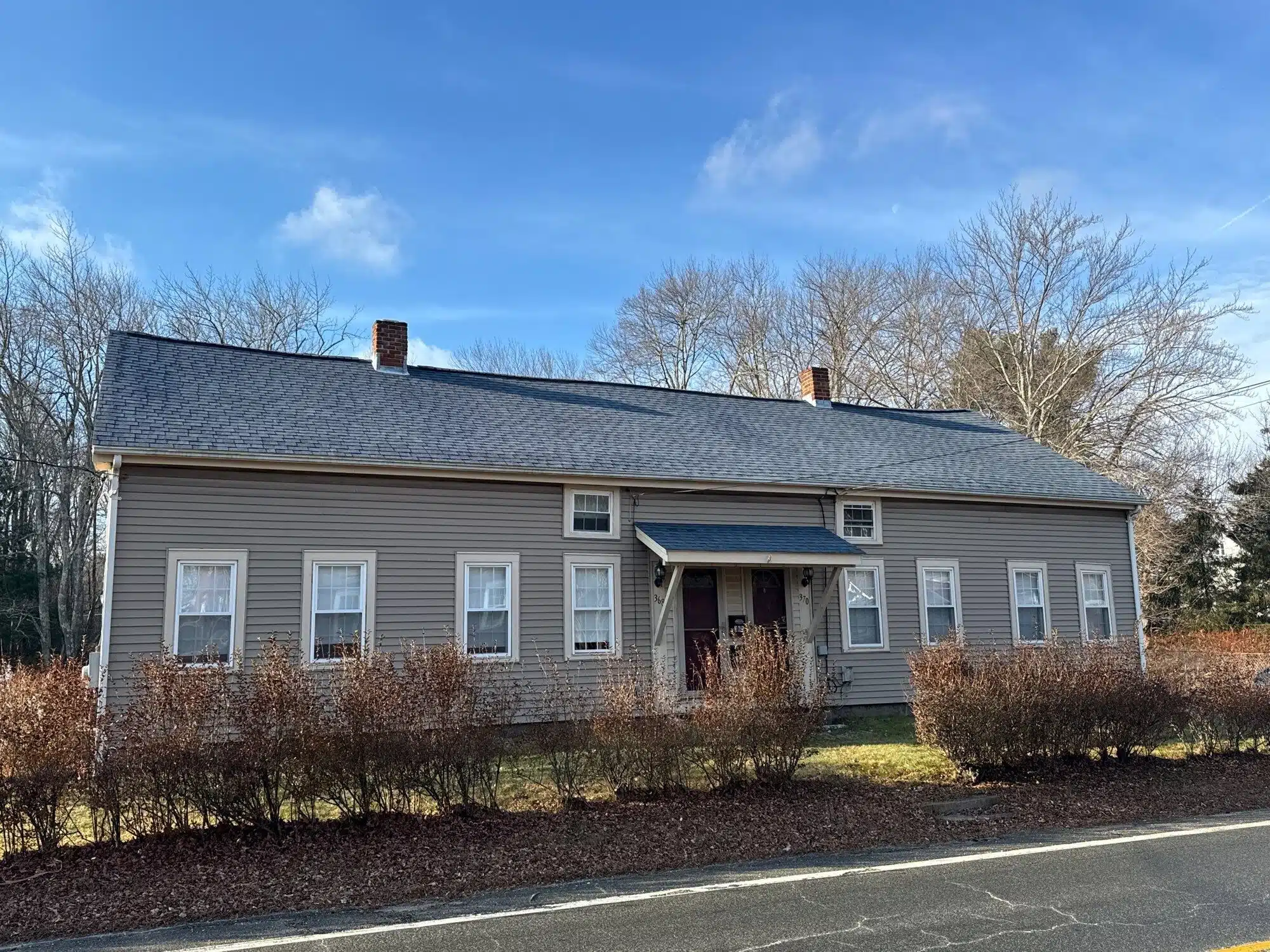
This long antique New England farmhouse in Burrillville — a gable-front-and-ell colonial wrapped in weathered gray clapboard, with two brick chimneys rising above the roadside hedgerow — carries generations of history under its roof, and old houses like this breathe differently than new construction. When Pinnacle Roofing & Skylights replaced the roof across the main house and its long ell with new architectural asphalt shingles, the real story wasn’t only the crisp new ridge line; it was the balanced attic ventilation built underneath it to move damp air out of a structure that has stood through more winters than anyone can count.
Scope of Work
The re-roof covered the full span of the main house and the attached ell, and every course of new architectural asphalt shingles was installed over a properly ventilated deck. Because an antique farmhouse has an attic that readily traps moisture — decades of clapboard, plaster, and old framing hold and release humidity — the ventilation plan mattered as much as the shingles. Pinnacle installed a continuous ridge vent along the peak for exhaust and confirmed clear intake down at the eaves so the two work as one balanced system. That pairing is the heart of Pinnacle’s Attic Ventilation Solutions, and on a house of this age it is the difference between an attic that stays dry and one that slowly rots its decking from the inside.
What We Installed (And Why)
Running the length of the new roof peak is a continuous ridge vent — low-profile, tucked under the ridge cap so it disappears into the clean line of the finished roof, with no moving parts to wear out and no spinning turbine to seize. It is baffled against wind-driven rain, which matters on an exposed rural lot, and because it runs the entire ridge it pulls stale air evenly from every corner of the attic rather than leaving dead pockets the way a handful of scattered box vents would.
A ridge vent only works if fresh air can get in low, so the system is balanced with intake at the eaves. Cool outside air enters at the soffit, rises as it warms and picks up moisture, and leaves at the ridge in a steady, continuous loop. On this farmhouse that loop is doing quiet, essential work all year: carrying out the everyday humidity an old house generates before it can condense on cold framing and feed mold or rotted decking.
Project Photo Gallery


Good To Know: Why Does an Old Farmhouse Attic Need Ventilation Most?
Older homes were rarely built around the balanced ventilation that modern roofs are designed for, and the materials in an antique house — plaster, old wood lath, generations of framing — hold moisture readily. Through a Rhode Island winter, warm indoor air drifts up and meets a cold roof deck; without a way out, that moisture condenses, and over the years it can quietly rot decking and grow mold that no one sees until a repair opens the ceiling. A continuous ridge vent paired with eave intake gives that damp air a constant exit, protecting the very structure that makes an old farmhouse worth preserving.
Why Ridge Vent Ventilation Works
A balanced ridge-and-eave system works because it uses the way air naturally moves. Intake low at the eaves and exhaust high at the ridge, sized to roughly equal net free area, create a continuous convective flow with no fan and no electricity. In summer it flushes superheated air out from under the shingles, easing the cooling load and protecting the roof from baking itself out early. In winter it carries moisture up and away while keeping the deck cold and even in temperature, one of the best defenses against ice dams. It also keeps the attic dry enough to satisfy the ventilation requirements that keep most shingle manufacturer warranties valid.
Why Pinnacle
Pinnacle Roofing & Skylights has served Rhode Island since 2012 and is fully licensed — RI Residential License #39446 and Commercial License #261 — carrying more than 100 five-star Google reviews and an A+ rating with the BBB. Balanced attic ventilation isn’t an upsell here; a continuous ridge vent and matched eave intake are built into every roof we install, because a roof that can’t breathe won’t last no matter how good the shingles are. On an antique Burrillville farmhouse, that attention to the system beneath the surface is exactly what protects the home for the long haul.
Burrillville, RI
Burrillville is Rhode Island’s rural northwest corner — a town of historic villages, stone walls, working farms, and antique homes tucked along wooded back roads. Houses here weather real seasons and often carry a century or more of history, which makes a properly built, well-ventilated roof a genuine investment in preservation. See how we help homeowners across Burrillville keep their roofs sound for decades.
Wondering if your attic ventilation is doing its job in Burrillville? Use our instant estimate tool, book a free appointment, or call us today.
Planning a new roof? Proper attic ventilation is built into every Pinnacle roof system.
401-267-ROOF (7663)