
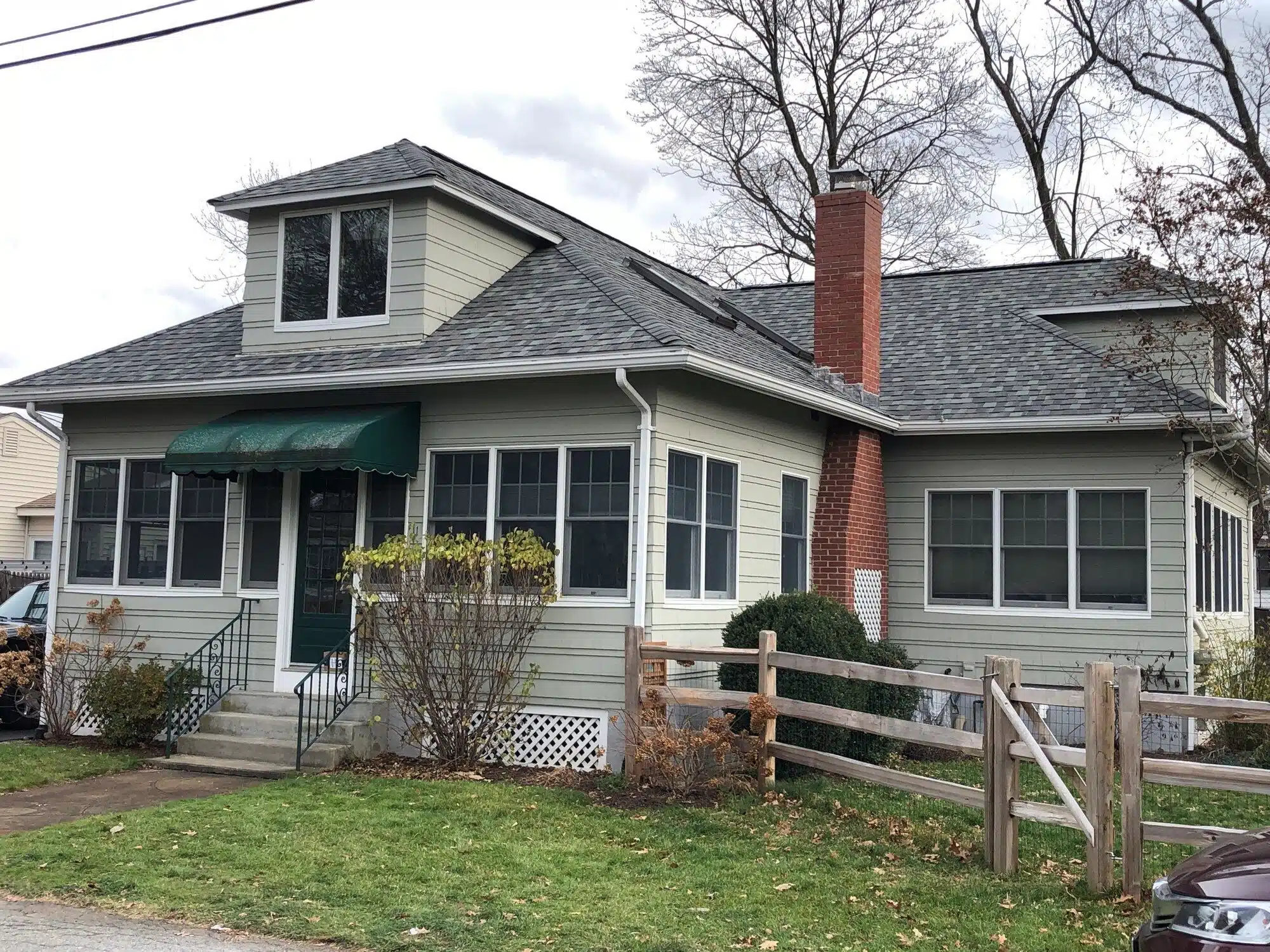

Like most Pinnacle projects, the work was completed efficiently — minimizing disruption for the property owner.
Pinnacle makes every project affordable with monthly financing options, including 0% interest for 18 months.
With its front-gable dormer, enclosed three-season sunporch, and cheerful green window awnings, this East Providence bungalow has plenty of character — and now a new Colonial Slate CertainTeed Landmark roof to match, its multi-tone gray wrapping a hip-and-gable roofline studded with skylights. Behind that handsome finish is a job most homeowners never think about until something goes wrong: moving moisture out of the attic. Every shower and every pot on the stove sends water vapor drifting upward, and without a way out it condenses on the cold roof deck — the quiet start of mold and rot. When we re-roofed this home, we built in a balanced ventilation system to keep that air moving. It is a concern shared by homes all over East Providence.
Scope of Work
This East Providence re-roof included a full tear-off, fresh underlayment, and the Colonial Slate CertainTeed Landmark shingles now running across the hip-and-gable roof. The skylights were re-flashed and sealed, the brick chimney flashing was rebuilt, and along the peak we installed a continuous ridge vent working with clear intake at the eaves — the balanced approach detailed on our Attic Ventilation Solutions page. On a home with an enclosed sunporch and everyday indoor humidity, that steady exhaust path is what keeps moisture from collecting under the deck. Matching intake and exhaust across a hip roof is the part that protects the structure long after the shingles are down.
What We Installed (And Why)
At the top of the system is a continuous ridge vent running the full length of the peak, set low under the Colonial Slate ridge cap for a clean, uninterrupted line. Rather than punching the roof with several box vents that ventilate only the space right around them, the continuous vent draws air out of the entire attic evenly, leaving no damp corners behind. It has no moving parts and is baffled against wind-driven rain, so the exhaust path stays open even around the skylights and dormer that break up this roofline.
The exhaust only works if fresh air can enter, so we confirmed unobstructed intake low at the eaves and soffits. As outside air flows in at the bottom and rises out at the ridge, it continuously carries humid indoor air out of the attic before it can condense. In Rhode Island’s climate, warm, moist air meeting a cold roof deck is what grows mold, darkens sheathing, and rots decking. By keeping that air moving beneath the Colonial Slate Landmark shingles, this balanced system protects the wood you never see — and helps keep the shingle warranty valid, since adequate ventilation is a manufacturer requirement.
Project Photo Gallery


Good To Know: Can attic ventilation really prevent mold and rot?
It is one of the best defenses there is. Ordinary daily living — cooking, showering, laundry — pushes water vapor into the air, and that moisture rises into the attic. When it meets a cold roof deck it condenses into droplets, and a damp deck is where mold and wood rot begin. A balanced ventilation system gives that moist air a constant way out: in at the eaves, out at the ridge. Keeping the attic dry protects the decking, the insulation, and the framing, and it is often required to keep a shingle warranty in force. For an East Providence home with a sunporch and normal indoor humidity, that steady airflow quietly does a lot of work.
Why Ridge Vent Ventilation Works
Balanced ventilation relies on a simple loop: cool, dry air enters low at the eaves, and warm, moist air exits high at the ridge. Because the ridge vent spans the whole peak instead of a few box vents, the entire attic flushes evenly with no stagnant, humid pockets left to breed mold. The low-profile vent tucks under the Colonial Slate ridge cap, and its baffle keeps rain and snow out while letting stale air escape. No fans, no motors — just a continuous, natural current working day and night.
Why Pinnacle
Since 2012, Pinnacle Roofing & Skylights has built proper attic ventilation into every roof we install — it is part of the system, not an upgrade line. We are fully licensed in Rhode Island (Residential #39446, Commercial #261) and a CertainTeed ShingleMaster Premier contractor, qualified to install and stand behind the Colonial Slate Landmark shingles and skylights on this home. With more than 100 five-star Google reviews and a BBB A+ rating, East Providence homeowners trust us to protect the parts of the roof they can see and the ones they cannot.
East Providence, RI
East Providence overlooks the Seekonk River and Narragansett Bay, a settled city of tree-lined streets and early-twentieth-century homes with plenty of dormers, porches, and character. Older, well-lived-in houses like this one especially benefit from balanced ventilation, which keeps humidity from quietly damaging the structure. Learn more about our East Providence roofing services and how we keep attics dry from ridge to eave.
Wondering if your attic ventilation is doing its job in East Providence? Use our instant estimate tool, book a free appointment, or call us today.
Planning a new roof? Proper attic ventilation is built into every Pinnacle roof system.
401-267-ROOF (7663)