

Like most Pinnacle projects, the work was completed efficiently — minimizing disruption for the property owner.
Pinnacle makes every project affordable with monthly financing options, including 0% interest for 18 months.
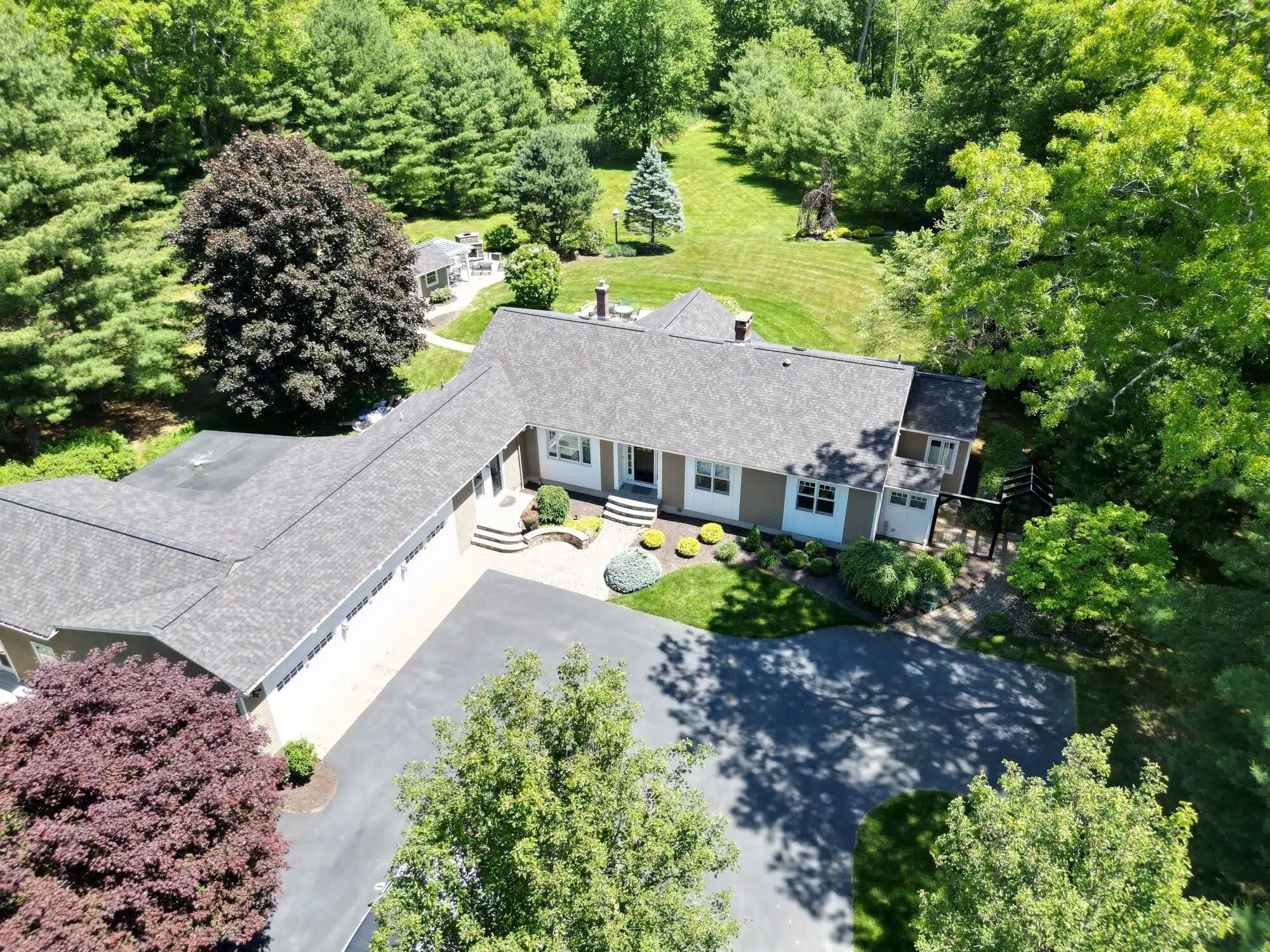
On this full re-roof of a sprawling ranch in Exeter, one of the smartest upgrades happened right along the peak. Instead of dotting the new roof with a handful of box vents, we ran a single continuous ridge vent the entire length of the ridge — a quieter, cleaner, more effective way to exhaust a Rhode Island attic. Here is why that choice matters and how the whole ventilation system came together.
Scope of Work
This asphalt-shingle replacement covered a long, low ranch roofline, and the ventilation plan was built around balancing intake and exhaust across that entire span. At the eaves we confirmed and cleared the soffit intake so air can enter low along the roof edge. Along the peak we cut one continuous ridge slot and installed an externally baffled ridge vent, then capped it beneath matching ridge shingles. Rather than relying on a few isolated box vents, we let the whole ridge do the exhausting — the balanced-airflow method at the core of our Attic Ventilation Solutions work on every roof we build.
What We Installed (And Why)
A continuous ridge vent and scattered box vents both move air, but they are not equals. Box vents exhaust only from the small area around each unit, which tends to leave stagnant pockets of hot, moist air between them, and every box vent is another penetration cut into the field of the roof. A continuous ridge vent, by contrast, exhausts evenly across the entire top of the attic through one clean slot at the highest point, so air is pulled uniformly from end to end with no dead zones.
We favor the ridge vent for the practical reasons too. It sits low-profile under the ridge cap and blends into the roofline instead of studding it with bumps, it has no moving parts to fail like a spinning turbine would, and its external baffle deflects wind and helps keep wind-driven rain and snow out while still drawing air. Paired with clear soffit intake at the eaves, it forms one continuous breathing path — cool air in low, warm air out high — that a cluster of box vents simply cannot match.
Project Photo Gallery


Good To Know: Can I just add more box vents instead of a ridge vent?
You can, but adding box vents rarely gives you the even, whole-attic airflow a continuous ridge vent provides, and each one is an extra hole in the roof. Mixing several exhaust types high on a roof can even let them short-circuit one another, pulling air from each other instead of from the soffits below. When we re-roof, we prefer a single continuous ridge vent matched to the soffit intake so the whole attic ventilates as one balanced system.
Why Ridge Vent Ventilation Works
The continuous ridge vent works because it puts the exhaust exactly where hot, moist air collects — at the very top of the attic — and stretches it across the full length of the ridge. Cooler air enters low at the soffits, warms, rises, and streams out the peak in a steady convective loop. Because that loop covers the entire deck rather than a few spots, and because there is nothing mechanical to wear out, it delivers consistent, maintenance-free airflow year-round. On a long ranch roofline like this one, that even coverage is especially valuable, since a few box vents would struggle to reach every end of such a wide attic.
Why Pinnacle
Pinnacle Roofing & Skylights is fully licensed in Rhode Island (Residential Lic #39446, Commercial Lic #261), carries a BBB A+ rating, and has collected 100+ five-star Google reviews from homeowners statewide. Since 2012 we have engineered balanced attic ventilation into every roof we install, because manufacturers require adequate ventilation to honor their warranties and because we would rather build it right the first time than come back to fix trapped-air problems later. On your roof, the exhaust is planned, not improvised.
Exeter, RI
Exeter is one of Rhode Island’s more rural, wooded communities, full of ranches and farmhouses set on open lots where roofs take the full brunt of sun, wind, and winter weather. Long, low rooflines like the ones here are ideal candidates for continuous ridge ventilation. We are glad to help Exeter homeowners get airflow that works as hard as the shingles above it.
Wondering if your attic ventilation is doing its job in Exeter? Use our instant estimate tool, book a free appointment, or call us today.
Planning a new roof? Proper attic ventilation is built into every Pinnacle roof system.
401-267-ROOF (7663)