
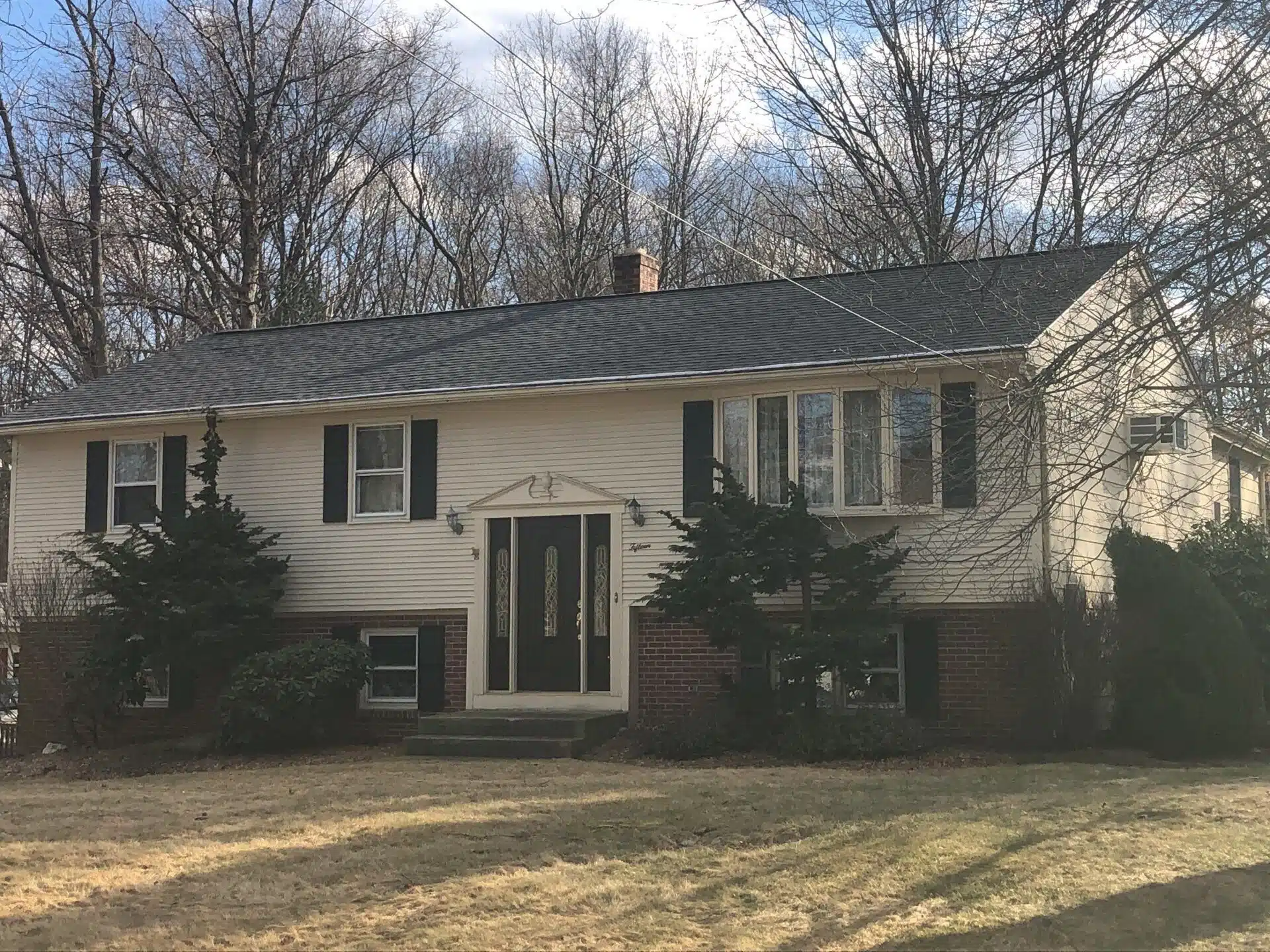

Like most Pinnacle projects, the work was completed efficiently — minimizing disruption for the property owner.
Pinnacle makes every project affordable with monthly financing options, including 0% interest for 18 months.
Drive around Johnston and you’ll still spot plenty of roofs dotted with box vents or topped by a spinning turbine — the older ways of venting an attic. This split-level recently got a full architectural-shingle roof replacement, and instead of scattering vents across the field of the roof, we ran a single continuous ridge vent along the peak. It’s a cleaner look and, more importantly, a more effective way to exhaust the whole attic. The finished ridge line tells the story: one uninterrupted vent doing the work that a patchwork of boxes never could.
Scope of Work
This full re-roof included a balanced ventilation system designed around a continuous ridge vent. After the tear-off, our crew confirmed and cleared the soffit intake, cut a continuous slot along the length of the peak, installed a baffled ridge vent, and capped it with matching ridge shingles. Rather than relying on the handful of box vents that came off with the old roof, the new system exhausts evenly across the entire ridge, matched to the intake below. You can see how we approach this on our Attic Ventilation Solutions page.
What We Installed (And Why)
A continuous ridge vent is our preferred exhaust for a good reason. Box vents only pull air from the small area immediately around each one, which leaves dead pockets of stagnant air between them, and every box is another penetration cut into the field of the roof. Spinning turbines add moving parts that wear out, seize, or rattle, and they only draw air when the wind turns them. The ridge vent replaces all of that with one low-profile opening running the entire length of the peak — no motors, no bearings, nothing to fail.
Because it spans the whole ridge, it ventilates the attic uniformly, flushing hot and moist air out of every bay rather than just the spots near a vent. It’s externally baffled to resist wind-driven rain and snow, and it tucks under the ridge cap shingles so it nearly disappears into the roofline instead of studding the roof with bumps. Paired with matched intake at the eaves, it gives this Johnston home a quieter, better-looking, and more thorough ventilation system than a scattering of boxes or a turbine ever would.
Project Photo Gallery


Good To Know: Is a ridge vent better than box vents or a turbine?
For most homes, yes. Box vents and turbines only ventilate the area near each unit, so parts of the attic can sit stagnant while others vent, and turbines add moving parts that eventually fail. A continuous ridge vent exhausts along the entire peak, giving even airflow across the whole attic with nothing to maintain. It also means fewer holes cut into the roof and a cleaner appearance, since one low vent under the cap shingles replaces a row of protruding boxes. When intake and exhaust are properly balanced, the ridge vent simply does the job more completely.
Why Ridge Vent Ventilation Works
A ridge vent works because it puts the exhaust exactly where hot air naturally collects — the highest line on the roof — and runs it continuously so no part of the attic is left out. Cool air enters at the eaves, rises up the roof deck, and leaves at the peak in one steady, even sweep. There are no moving parts and nothing to switch on; the natural rise of warm air and the draw from the intake below keep the cycle going on their own. It’s a simpler system than the alternatives, and simpler is what lasts.
Why Pinnacle
Pinnacle Roofing & Skylights builds a balanced ventilation system into every roof we install — we don’t leave a new roof relying on the tired box vents or turbines that came before it. We’ve served Rhode Island homeowners since 2012, we’re fully licensed (Residential Lic #39446, Commercial Lic #261), we hold a BBB A+ rating, and we’ve earned more than 100 five-star Google reviews. Proper ventilation isn’t an add-on here; it’s part of doing the roof right, and it’s what most shingle manufacturers require to keep their warranties in force.
Johnston, RI
Johnston sits just west of Providence, a suburban town with a strong mix of mid-century split-levels, ranches, and newer homes. Many of those older roofs were originally vented with box vents or turbines, which makes a re-roof the perfect time to upgrade to a cleaner continuous ridge system. We’re happy to help Johnston homeowners make that step — find out more on our Johnston roofing services page.
Wondering if your attic ventilation is doing its job in Johnston? Use our instant estimate tool, book a free appointment, or call us today.
Planning a new roof? Proper attic ventilation is built into every Pinnacle roof system.
401-267-ROOF (7663)