
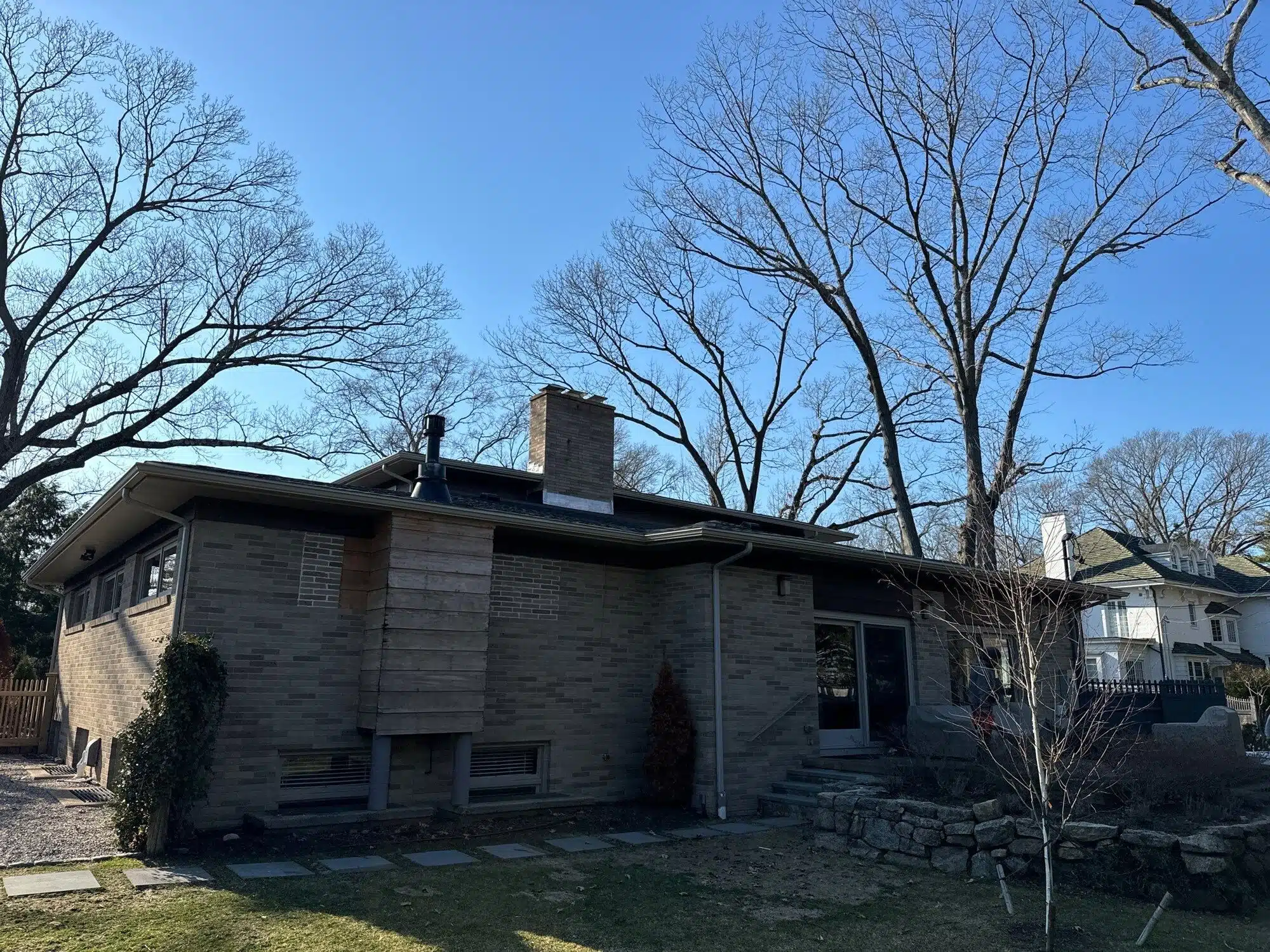

Like most Pinnacle projects, the work was completed efficiently — minimizing disruption for the property owner.
Pinnacle makes every project affordable with monthly financing options, including 0% interest for 18 months.
This Providence ranch was finished with a full asphalt-shingle re-roof and, importantly, a continuous ridge vent instead of the scattered box vents or spinning turbines you still see on older homes. The choice of exhaust matters: it decides how evenly the attic breathes, how the roofline looks, and even whether the shingle warranty stays valid. Box vents and turbines were common for decades, but they leave much of the attic under-served and add hardware that can fail. Here is why we build with a continuous ridge system on nearly every roof we install.
Scope of Work
This project included a complete tear-off, new asphalt shingles, and a ventilation system built to the manufacturer’s standard. We confirmed the soffit intake, cut a continuous slot along the peak, and installed an externally baffled continuous ridge vent beneath the ridge cap — a single, uniform exhaust line rather than a handful of box vents punched through the field of the roof. Our Attic Ventilation Solutions page explains how we match intake to exhaust so the whole system performs as designed.
What We Installed (And Why)
We favor a continuous ridge vent over box vents and turbines for a few clear reasons. Because it runs the full length of the peak, it ventilates the entire attic uniformly instead of creating pockets of stagnant air between a few scattered vents. It has no moving parts — unlike a wind turbine, there is nothing to seize, rattle, or wear out — and its external baffle resists wind-driven rain and snow. It also sits low under the cap shingles and simply disappears into the roofline, so there are no bulky vents dotting the view.
The other half of the equation is intake. We confirmed open soffit vents at the eaves so cool air enters low, rises through the attic, and exits at the ridge in a balanced loop. Matching intake to exhaust is not just about performance; adequate, correctly built ventilation is a condition most shingle manufacturers place on their warranty coverage. Installing the ridge vent to that standard protects both the roof and the homeowner’s coverage down the road.
Project Photo Gallery


Good To Know: Is a Ridge Vent Better Than Box Vents or a Turbine?
For most homes with a defined ridge, yes. Box vents only exhaust the small area around each one, leaving the rest of the attic under-served, and turbines rely on wind and add a moving part that can fail. A continuous ridge vent exhausts along the entire peak for even airflow, has nothing to break, and stays nearly invisible under the cap shingles. Just as important, it delivers the balanced ventilation that keeps shingle warranties intact — which the older mismatched setups often do not.
Why Ridge Vent Ventilation Works
A continuous ridge vent works with the natural movement of air rather than against it. Warm, moist air rises to the highest point of the attic, and the ridge slot gives it a continuous exit the full length of the roof, while intake at the eaves feeds the loop with cooler air below. The result is a steady, passive convection current — no motor, no wind dependence, no maintenance — that exhausts heat in summer and moisture in winter, evenly, across the whole attic.
Why Pinnacle
Pinnacle Roofing & Skylights has served Rhode Island since 2012, and we build proper, balanced ventilation into every roof we install — a continuous ridge system done to the standard shingle manufacturers require to keep their warranties valid. We are fully RI licensed (Residential Lic #39446, Commercial Lic #261), carry a BBB A+ rating, and hold more than 100 five-star Google reviews from homeowners across the state. When we finish a roof, its ventilation is done right, not improvised.
Providence, RI
Providence is the capital and a city of neighborhoods, from historic three-deckers to mid-century ranches like this one. Its dense housing stock and mix of roof shapes make thoughtful, code-conscious ventilation especially valuable when a roof is replaced. Getting the exhaust right the first time protects both the home and the manufacturer coverage that comes with a new roof. We are proud to serve the city; learn more about our work in Providence and the surrounding metro.
Wondering if your attic ventilation is doing its job in Providence? Use our instant estimate tool, book a free appointment, or call us today.
Planning a new roof? Proper attic ventilation is built into every Pinnacle roof system.
401-267-ROOF (7663)