
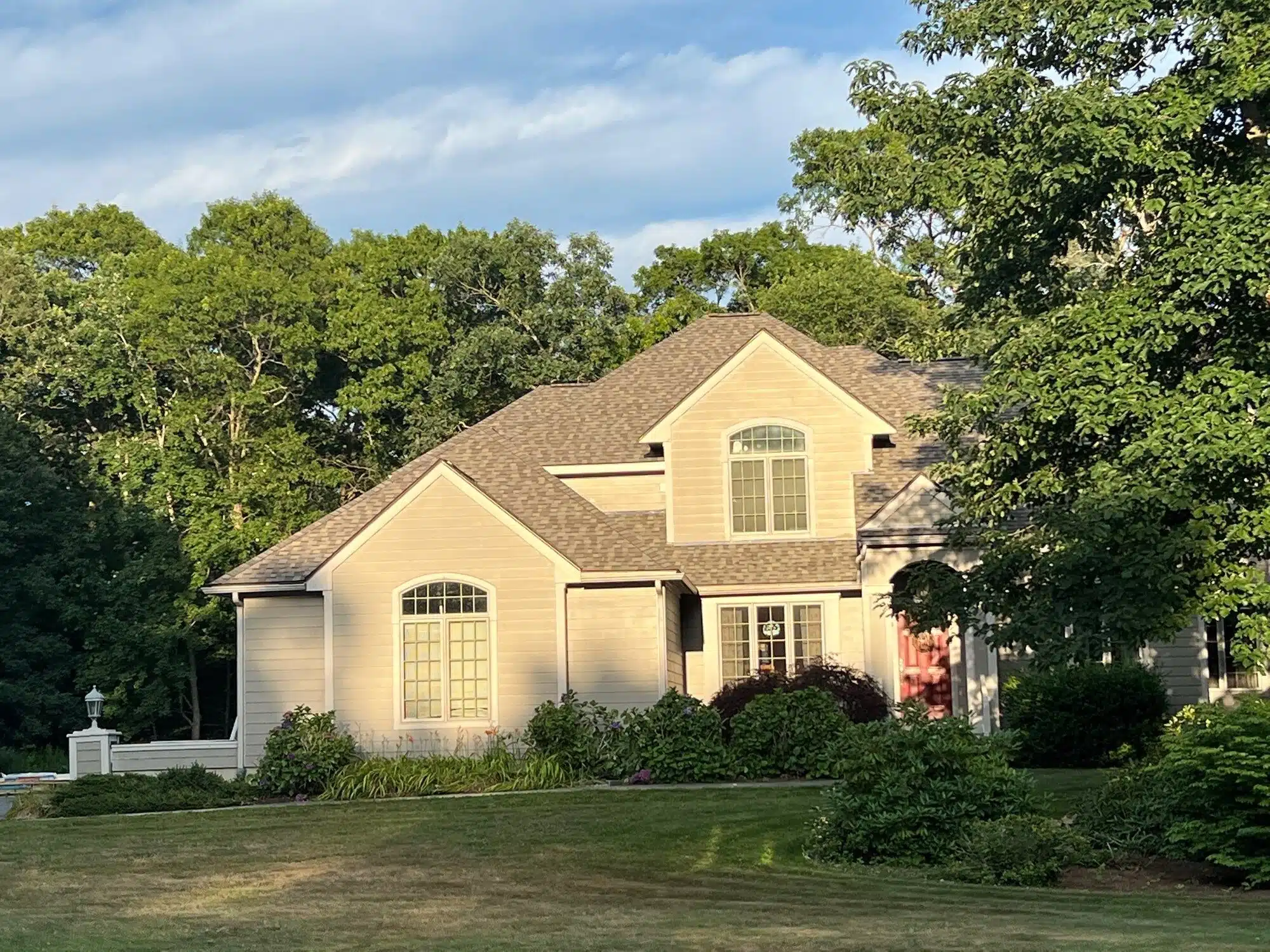

Like most Pinnacle projects, the work was completed efficiently — minimizing disruption for the property owner.
Pinnacle makes every project affordable with monthly financing options, including 0% interest for 18 months.
On a warm July afternoon, the attic of a Tiverton home can become the hottest room in the house — a sealed pocket of superheated air pressing down on the living space and radiating up against the shingles. When we re-roofed this tan, weatherwood-shingled home, we treated that trapped heat as a problem worth solving, not an afterthought. The new asphalt-shingle roof looks sharp from the street, but the continuous ridge vent along its peak is what gives the attic a way to exhale on the hottest days of summer.
Scope of Work
This project was a full pitched asphalt-shingle re-roof, and a balanced attic ventilation system was part of the plan before the first bundle of shingles arrived. After tearing off the old roof and prepping the deck, we confirmed the soffit intake was clear and open, cut a continuous exhaust slot along the ridge, installed a baffled continuous ridge vent, and finished it under matching ridge cap shingles. Intake at the bottom and exhaust at the top were sized to move air together — the same balanced approach detailed on our Attic Ventilation Solutions page. The result is a roof that not only sheds water but actively vents the heat that builds up beneath it all summer long.
What We Installed (And Why)
We installed a continuous ridge vent that runs the full length of the peak, chosen deliberately over box vents or turbines. Because it spans the entire ridge, hot air escapes evenly across the whole attic instead of only near a few isolated openings. It sits low under the ridge cap so it keeps the roofline clean, has no moving parts to wear out, and its external baffle helps it resist wind-driven rain while still drawing air out. On a summer day, that continuous exhaust lets the superheated air at the top of the attic keep leaving instead of stacking up.
To make the ridge vent effective, we matched it with intake down low at the eaves and soffits. Cooler outside air enters there, moves up through the attic as it heats, and exits at the peak — a steady convection loop that runs on its own. When intake and exhaust are balanced, that loop stays strong, pulling heat out continuously rather than letting it pool against the deck. Easing that heat load helps protect the shingles from cooking off from below and takes strain off the home’s cooling system in a heat wave.
Project Photo Gallery


Good To Know: Can better attic ventilation really help in the summer?
Yes. In summer, sun beating on the roof drives attic temperatures well above the outdoor air, and that heat radiates down into the rooms below and presses against the shingles from underneath. A balanced ventilation system gives the hottest air a constant path out at the ridge while pulling cooler air in at the eaves, so heat does not simply accumulate. That helps protect the shingles from premature aging caused by heat from below, and it eases the load on your air conditioning by keeping the attic from turning into a heat reservoir. It is one of the simplest, most reliable ways to make a roof work smarter in the warm months.
Why Ridge Vent Ventilation Works
Ridge vent ventilation works by harnessing a basic fact of physics: hot air rises. In a hot attic, the warmest air collects at the very peak — exactly where the continuous ridge vent gives it a full-length door to escape. As that air rushes out, it draws fresh air in through the low soffit intake, creating a continuous, self-powered current that needs no fans or electricity. Spanning the whole ridge means the entire attic vents evenly, with no stagnant hot spots left behind. The same loop that flushes summer heat also carries out winter moisture and helps keep the deck stable year-round. With no moving parts and a low profile beneath the ridge cap, it is a system that quietly does its job for the life of the roof.
Why Pinnacle
Since 2012, Pinnacle Roofing & Skylights has built complete roof systems across Rhode Island — and balanced attic ventilation is standard on every single one. We are fully licensed in Rhode Island (Residential Lic #39446, Commercial Lic #261), carry a BBB A+ rating, and hold a 5.0-star average from 100+ five-star Google reviews. Because adequate ventilation is required to keep most shingle manufacturers’ warranties valid, building it in correctly protects your investment as well as your comfort.
Tiverton, RI
Tiverton stretches along the eastern shore of the Sakonnet River, a mix of historic village neighborhoods, wooded lots, and homes that catch the full strength of a New England summer sun. Roofs here work hard through hot, humid stretches and cold winters alike, which makes airflow beneath the shingles as important as the shingles themselves. Pinnacle is proud to provide complete roofing service in Tiverton, ventilation included on every job.
Wondering if your attic ventilation is doing its job in Tiverton? Use our instant estimate tool, book a free appointment, or call us today.
Planning a new roof? Proper attic ventilation is built into every Pinnacle roof system.
401-267-ROOF (7663)