
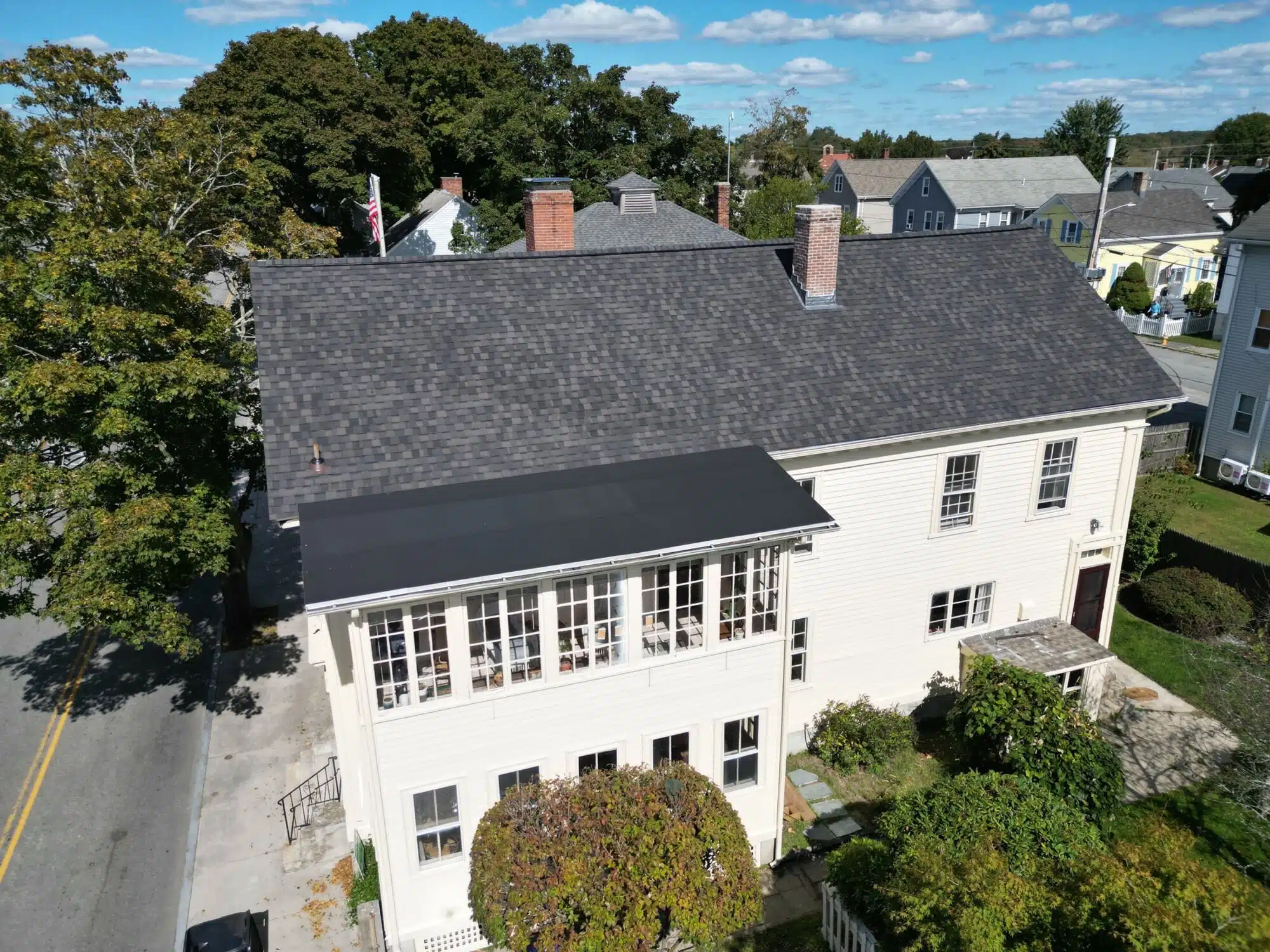

Like most Pinnacle projects, the work was completed efficiently — minimizing disruption for the property owner.
Pinnacle makes every project affordable with monthly financing options, including 0% interest for 18 months.
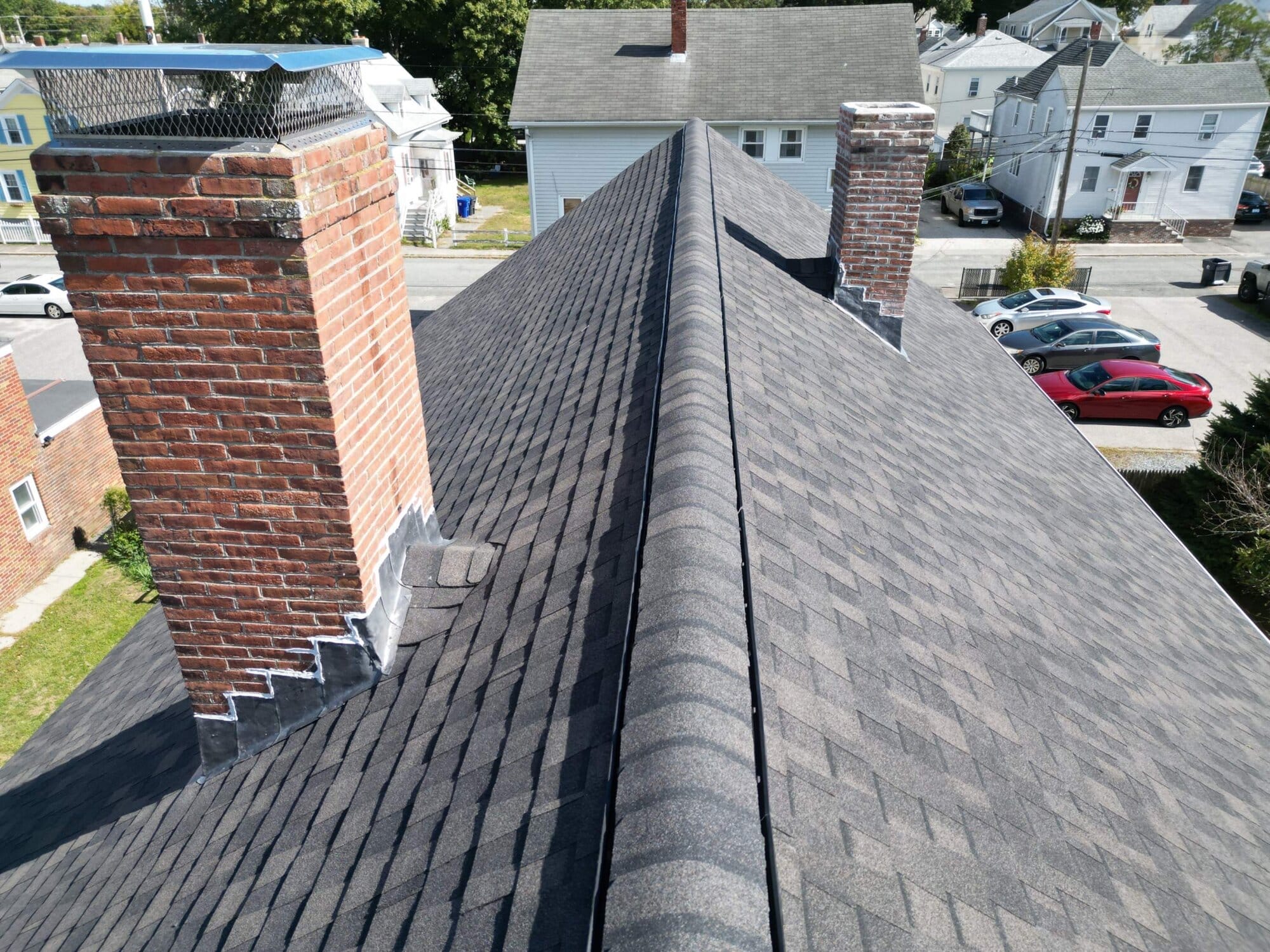
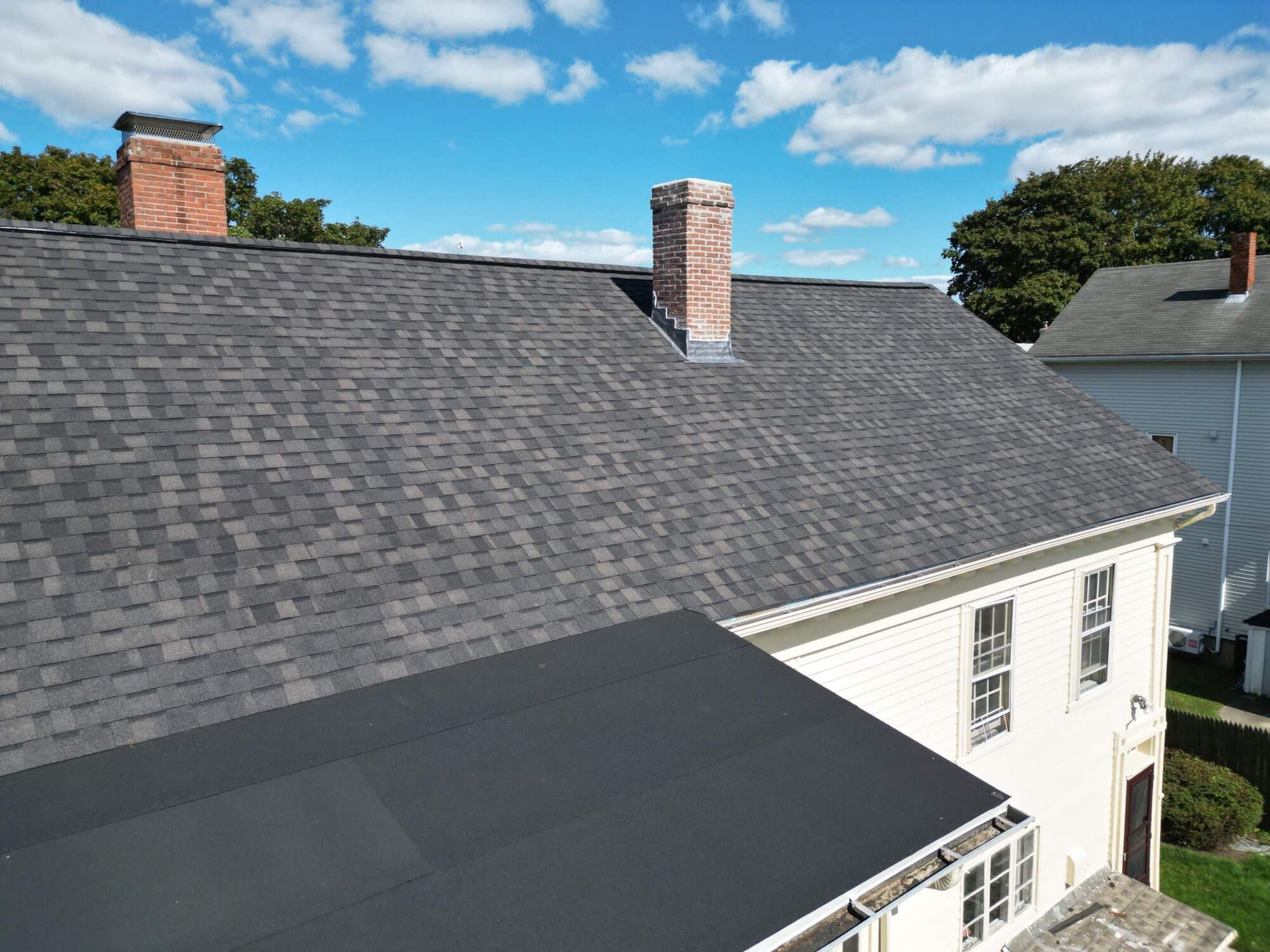
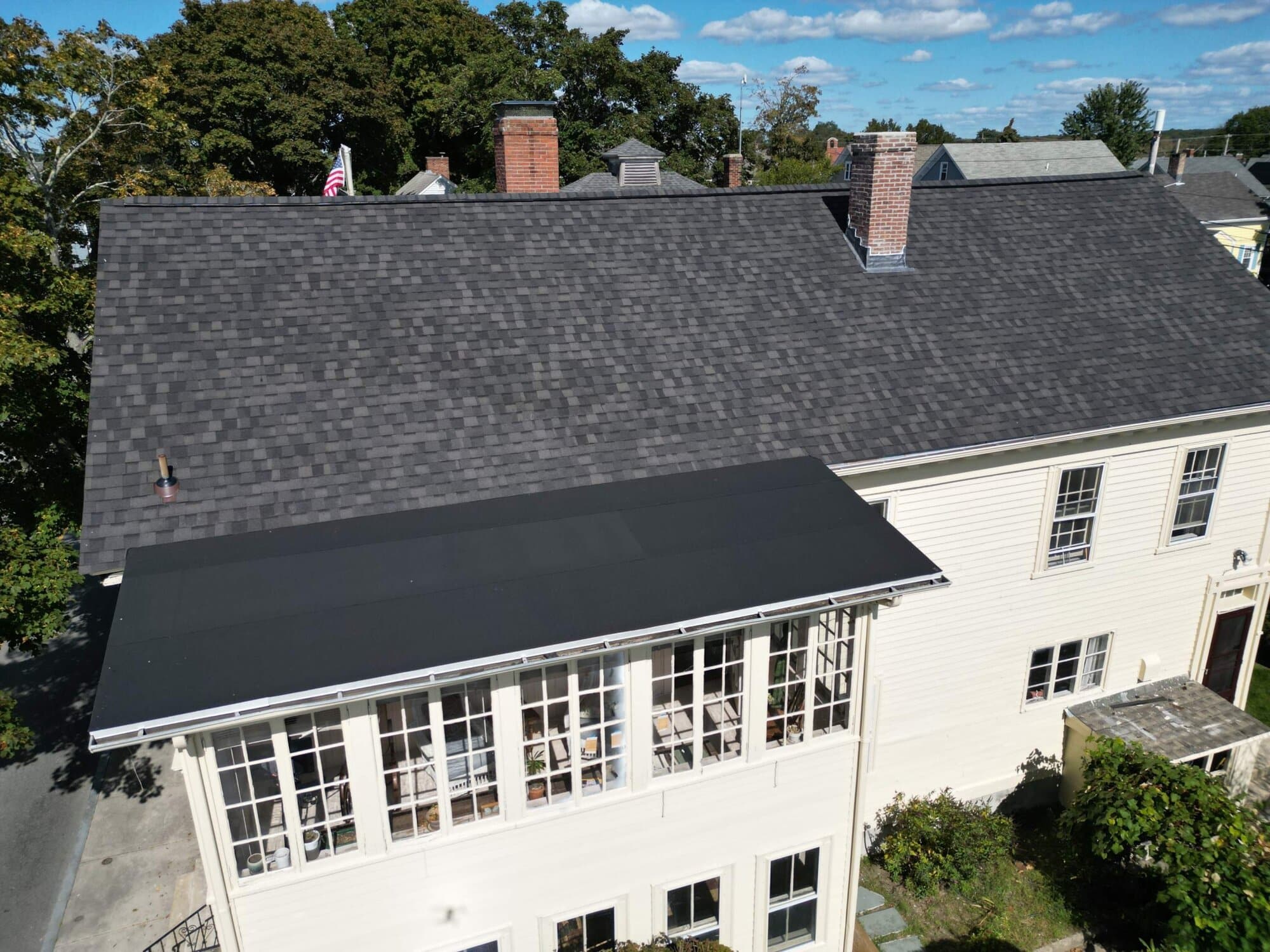
Stately and white against the mature trees of a Warren village street, this large colonial — Federal in its lines, with several brick chimneys standing tall above a steep gable roof and a glassed sunroom addition off one side — is exactly the kind of home where winter ventilation earns its keep. When Pinnacle Roofing & Skylights re-roofed it with new architectural asphalt shingles, the steep pitch and long ridge gave us an ideal run for a continuous ridge vent — the exhaust half of a balanced attic system designed to keep this roof deck cold and even through the worst of a New England freeze, when ice dams do their damage.
Scope of Work
New architectural asphalt shingles went on across the main colonial’s steep gable roof, working cleanly around the several brick chimneys that punctuate the ridge. Beneath the new roof, the priority was a balanced ventilation system suited to a tall, steeply pitched attic: a continuous ridge vent running the full length of the peak for exhaust, matched to intake at the eaves so air moves in a steady loop. This balanced approach is the core of Pinnacle’s Attic Ventilation Solutions, and on a home this size — with a large attic volume under a steep roof — even, whole-attic airflow is what keeps the deck uniformly cold in winter and prevents the warm spots that start ice dams.
What We Installed (And Why)
Along the peak of the finished roof runs a continuous ridge vent, low-profile beneath the ridge cap so it keeps the crisp, traditional line a colonial deserves. It has no moving parts and no motor, it is baffled to shed wind-driven rain and snow, and because it spans the entire ridge it ventilates the whole attic evenly instead of leaving stagnant pockets the way box vents or a turbine would. On a steep roof with a big attic, that even coverage is exactly what you want.
Exhaust at the ridge is only half the system, so it is balanced with fresh-air intake down at the eaves. Cold outside air enters low at the soffit and flows up and out at the ridge, and that constant sweep keeps the entire roof deck at one cold temperature. When the deck stays uniformly cold, snow melts evenly and drains instead of refreezing at the eaves — which is precisely how ice dams and the leaks they cause get started.
Project Photo Gallery
Good To Know: How Does Attic Ventilation Prevent Ice Dams?
Ice dams form when heat escaping into the attic warms the middle of the roof, melts the snow on it, and lets that meltwater run down to the cold eave — where it refreezes into a ridge of ice that backs water up under the shingles. A balanced ridge-and-eave ventilation system fights this by flushing that warm air out and keeping the whole deck cold and even, so snow melts at the same rate everywhere and drains off the roof instead of pooling and freezing. On a steep colonial roof over a large Warren attic, that even, cold deck is one of the best defenses a homeowner has against winter leaks.
Why Ridge Vent Ventilation Works
The system works because it lets physics do the labor. Intake low at the eaves and exhaust high at the ridge, sized to roughly equal net free area, set up a continuous convective flow that needs no fan and no power. Through the summer it exhausts superheated attic air, protecting the shingles from cooking and easing the cooling load; through the winter it carries moisture out and holds the deck cold and even to resist ice dams. Keeping the attic properly ventilated also satisfies the requirement that keeps most shingle warranties valid — a detail many roofs quietly fail.
Why Pinnacle
Pinnacle Roofing & Skylights has been a licensed Rhode Island roofer since 2012 — RI Residential License #39446 and Commercial License #261 — with more than 100 five-star Google reviews and an A+ BBB rating. On every roof we install, a continuous ridge vent and balanced eave intake come standard, because ventilation isn’t a luxury add-on; it’s what keeps the deck sound, the attic dry, and the warranty valid. On a historic colonial in Warren, that means the roof looks right and performs right through every season.
Warren, RI
Warren is one of the East Bay’s most walkable historic towns, a compact grid of Federal and colonial homes, working waterfront, and tree-lined village streets along the Warren and Palmer rivers. Its older housing stock — steep roofs, big attics, real winters — rewards a roof that is ventilated as carefully as it is shingled. Learn how Pinnacle serves homeowners throughout Warren.
Wondering if your attic ventilation is doing its job in Warren? Use our instant estimate tool, book a free appointment, or call us today.
Planning a new roof? Proper attic ventilation is built into every Pinnacle roof system.
401-267-ROOF (7663)