
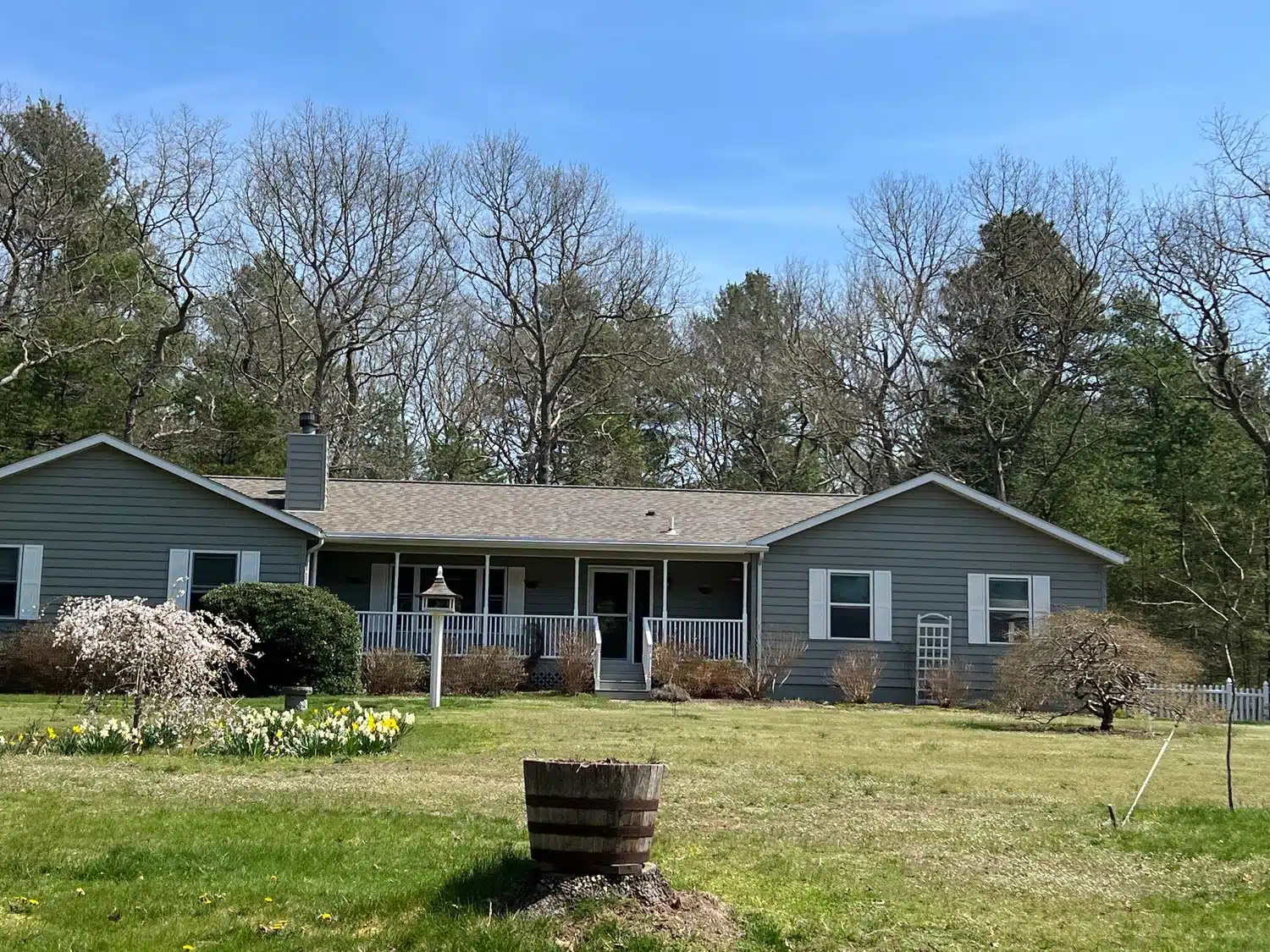

Ask most homeowners about roof ventilation and they picture the ridge vent along the peak. But a ridge vent is only half of a working system — it is the exhaust, and it cannot move any air at all without an equal amount of intake down at the eaves. This Charlestown home got a new CertainTeed Landmark PRO roof in Weathered Wood built over a balanced system where the intake was treated as carefully as the exhaust, which is exactly what makes attic ventilation actually work. Pinnacle roofs go on fast — often as a one-day roof replacement — and flexible financing keeps a project like this within reach, with plans as low as 0% interest for 18 months.
A Charlestown home received a new CertainTeed Landmark PRO roof in Weathered Wood, with a low-slope section in EPDM rubber, built over a balanced ventilation system where soffit intake was matched to ridge exhaust so air actually moves through the attic. This project is in Charlestown, Rhode Island, finished in CertainTeed Landmark PRO — Weathered Wood.
Scope of Work
The re-roof began by confirming the part of ventilation that is easiest to get wrong: intake. Air was verified and opened at the soffits along the eaves so fresh air can enter the attic low, and a continuous ridge vent was set at the peak to exhaust warm, moist air high — a balanced pairing, not exhaust alone. Only then did the weather system go on: ice-and-water shield at the eaves and valleys, synthetic underlayment across the field, and new drip edge and starter. The steep slopes were coursed in Landmark PRO shingles in Weathered Wood, and the home’s low-slope section was rebuilt as an EPDM rubber membrane where the pitch is too shallow for shingles. Hip and ridge caps finished the peak over the ridge vent. By making sure intake and exhaust were matched, the finished roof breathes along its whole length instead of just looking like it should.
What We Installed (And Why)
This roof pairs a premium shingle with a ventilation system built to actually function. CertainTeed Landmark PRO is the heavier-weight member of the Landmark family — a dual-layer architectural shingle with more mass than standard Landmark, a 130 mph wind rating, a Class A fire rating, Max Def color depth, and StreakFighter algae resistance, installed to earn CertainTeed’s strongest SureStart™ PLUS warranty. Its Weathered Wood color is a soft blend of gray and tan that gives the roof a natural, settled look. But the part that determines how long this roof lasts is the airflow beneath it, and here is the detail most contractors skip: a ridge vent can only exhaust as much air as the soffits let in. Ventilation is a balanced system — intake low at the eaves, exhaust high at the ridge — and if the intake is blocked by insulation, painted-over soffit vents, or simply never opened, the ridge vent has nothing to pull and the attic does not breathe no matter how much exhaust is installed. An unventilated attic bakes the shingles from below in summer and traps moisture against the deck in winter, aging the roof early and jeopardizing its warranty. Getting the intake right — clear, open soffit vents matched to the ridge exhaust — is what lets cool air wash up the underside of the deck and carry heat and moisture out the top. It is the unglamorous half of ventilation, and it is the half that makes the whole system work.
Project Photo Gallery


Good To Know: Why isn’t a ridge vent enough on its own?
Because a ridge vent is only the exhaust half of a ventilation system, and exhaust cannot move air without intake to feed it. Think of it like a straw: a ridge vent is the top of the straw, but if the bottom is plugged, nothing flows no matter how open the top is. In a roof, the ‘bottom’ is the soffit intake vents along the eaves, and they have to let in at least as much air as the ridge is trying to push out. When the intake is missing, blocked by insulation stuffed into the eaves, or sealed under layers of paint, the ridge vent has nothing to draw from — and in the worst case it can even start pulling air from inside the house or from other roof openings, which is exactly the opposite of what you want. The result is an attic that does not actually breathe: it superheats in summer and bakes the shingles from below, and it traps moisture in winter that condenses on the cold deck and rots it. A roof can have a beautiful continuous ridge vent and still suffer all of this if the intake was never addressed. That is why a proper re-roof, like this Charlestown project, treats intake and exhaust as one balanced system — confirming and opening the soffit vents so the ridge vent has the airflow it needs to protect the roof from the inside out.
Why This Approach Works
Attic ventilation only works when intake and exhaust are balanced — a ridge vent can exhaust only as much air as the soffit intake allows in. Opening and matching the soffit intake to the ridge exhaust is what makes air actually move through the attic, protecting the deck and shingles from summer heat and winter moisture.
Why Pinnacle
Ventilation rewards a contractor who builds the intake half of the system as carefully as the exhaust, so the attic actually breathes rather than just appearing to. As a CertainTeed ShingleMaster™ Premier contractor, Pinnacle qualifies our customers for CertainTeed’s full SureStart™ PLUS extended warranty — coverage most contractors cannot offer. We’ve served Rhode Island since 2012, hold a 5.0-star Google rating across 100+ reviews and an A+ BBB rating — see our full credentials.
Charlestown, Rhode Island
Charlestown is a South County shoreline town of woods, ponds, and homes set among the trees, from tucked-away cottages to open-lawn ranches like this one. Coastal humidity and tree cover both press moisture against a roof, which makes working attic ventilation especially valuable here — and makes the intake half of the system, so often overlooked, all the more important to get right. A Landmark PRO roof built over a genuinely balanced ventilation system is well matched to how Charlestown homes weather their climate. Explore our work across Charlestown roofing services.
Need a roofing estimate in Charlestown? Use our instant estimate tool, book a free appointment, or call us today.
Exploring payment options? Ask about financing — plans as low as 0% interest for 18 months.
401-267-ROOF (7663)
Frequently Asked Questions
How do I know if my attic has enough intake ventilation?
The clearest signs of poor intake are an attic that is scorching in summer, frost or moisture on the underside of the roof deck in winter, or ice dams forming at the eaves. Physically, intake comes from soffit vents along the eaves — if they are missing, painted shut, or blocked by insulation pushed into the eaves, your intake is likely inadequate. A roofer can confirm the balance during an inspection; the goal is at least as much intake at the eaves as exhaust at the ridge.
Can you add soffit intake vents during a re-roof?
Yes, and a re-roof is the ideal time. While the roof edge is open, a roofer can add or clear soffit vents, install baffles that keep insulation from blocking the airflow at the eaves, and make sure the intake is matched to the ridge exhaust being installed at the peak. Addressing intake and exhaust together is what produces a genuinely balanced system rather than an exhaust vent with nothing feeding it.
What is CertainTeed Landmark PRO in Weathered Wood?
Landmark PRO is the heavier-weight version of CertainTeed’s Landmark architectural shingle — more mass, a 130 mph wind rating, Max Def color depth, and eligibility for the strongest SureStart PLUS warranty when installed to spec. Weathered Wood is a soft gray-and-tan blend that gives a roof a natural, weathered appearance suited to a wide range of homes.
More Resources for Charlestown
- Charlestown Roofing Services
- Residential Roofing
- CertainTeed Shingles
- Residential Roofing
- One-Day Roof Replacement
- Financing Available
- Instant Roof Estimate
- Showcase Gallery
Browse more of our Rhode Island project galleries:
Explore all Rhode Island Roofing Projects →Explore all CertainTeed Shingle Projects →