
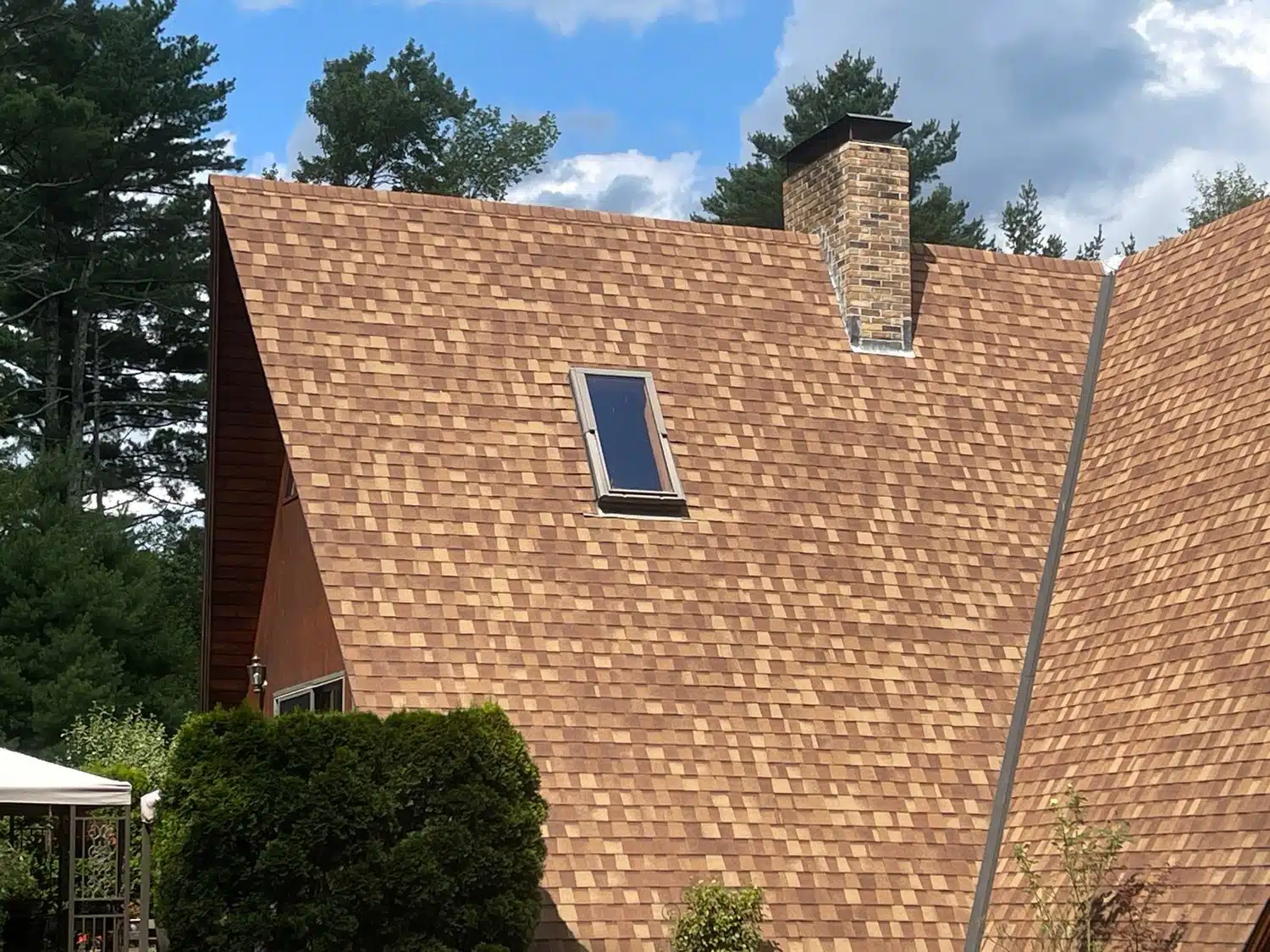

An A-frame is almost all roof and very little wall — which makes it one of the hardest houses to get daylight into, and the one where skylights matter most. This Clayville A-frame, with its cedar-shingle roof, got four VELUX skylights that bring daylight deep into a home whose walls could never carry enough windows.
A Clayville A-frame home with a cedar-shingle roof received four VELUX skylights, bringing daylight into a house whose steep, wall-scarce design leaves little room for conventional windows. This project is in Clayville, Rhode Island using VELUX skylights.
Scope of Work
The project set four skylights into the steep cedar roof that forms most of the house. Each VELUX unit was placed to light the rooms and loft spaces beneath the A-frame’s slopes, and each was flashed with its engineered metal kit into the cedar-shingle courses, with ice-and-water membrane lapped up the curb, so the openings are watertight on a steep roof that sheds a great deal of water. Cedar-shingle roofs take particular care to flash correctly around a penetration, and getting that right on four skylights is what lets the A-frame gain daylight without gaining leaks. Inside, the skylights open the tall, sloped ceilings to the sky, lighting spaces a wall window on an A-frame simply cannot reach.
What We Installed (And Why)
The A-frame is a beautiful, distinctive design with one built-in problem: it is mostly roof. The two great slopes that give an A-frame its shape come almost all the way to the ground, which leaves only the small gable ends — front and back — to hold windows. That means the interior, especially the upper loft levels tucked under the peak, can be dramatically short on daylight, because there is simply no wall to put a window in. Skylights are the answer, and on an A-frame they are less a luxury than a necessity: set into the great sloping roof, they bring daylight to exactly the spaces the design starves of it. Four VELUX units here light the home along its slopes, and because they are VELUX they are flashed with engineered metal kits rather than caulk, so they stay dry. The roof is cedar shingle, which asks for extra care at every penetration — cedar is laid differently than asphalt, and the flashing has to be woven into the coursing so water sheds around each skylight cleanly. On a steep A-frame roof that sheds water fast and hard, correct flashing on all four skylights is what keeps the daylight coming without a leak. The result is an A-frame that finally lives as bright inside as its dramatic shape promises — the tall, sloped ceilings opened to the sky, the loft spaces lit, and the whole interior transformed by daylight that the walls could never have delivered.
Project Photo Gallery


Good To Know: Why are skylights so important on an A-frame house?
Because an A-frame is mostly roof and very little wall, which leaves it starved for the daylight that ordinary houses get through their windows. The defining feature of an A-frame — the two steep roof slopes that run nearly to the ground — means there is almost no vertical wall to hold windows; only the small triangular gable ends, front and back, can take conventional glazing. As a result, the interior, and especially the loft and upper spaces tucked under the peak, can be surprisingly dark, because daylight has no way in from the sides. Skylights solve this in the only way an A-frame allows: set into the vast sloping roof, they open the interior directly to the sky and bring daylight to exactly the spaces the design leaves dim. That is why on an A-frame skylights are less an upgrade than a necessity — they are often the primary source of daylight for whole rooms. The installation does demand care, particularly on a cedar-shingle roof like this Clayville home’s, where each skylight has to be flashed with engineered metal woven into the cedar coursing so the steep roof sheds water around it cleanly. Done right, skylights let an A-frame live as bright and open inside as its striking shape suggests from the outside — which is exactly what four well-placed VELUX units did here.
Why This Approach Works
An A-frame is almost all roof and little wall, so it is starved of daylight from windows — skylights set into the great sloping roof are the primary way to light it. Flashing each unit with engineered metal into the cedar coursing is what brings that daylight without leaks on a steep roof.
Why Pinnacle
Skylight work on an A-frame and a cedar roof rewards a contractor who understands both the daylighting challenge and the careful flashing a steep cedar roof demands. Pinnacle installs as a VELUX 5-Star Skylight Specialist, to the manufacturer’s specification. We’ve served Rhode Island since 2012, hold a 5.0-star Google rating across 100+ reviews and an A+ BBB rating — see our full credentials.
Clayville, Rhode Island
Clayville is a small village in the wooded heart of Scituate, in rural western Rhode Island, where distinctive homes like A-frames sit among the trees. Those wooded lots and steep-roofed designs make daylight from skylights especially valuable. Four VELUX skylights set into a cedar A-frame roof suit both the architecture and the shaded setting of a Clayville home. Explore our work across Clayville roofing services.
Need a roofing estimate in Clayville? Use our instant estimate tool, book a free appointment, or call us today.
401-267-ROOF (7663)
Frequently Asked Questions
Can you put skylights in a cedar-shingle roof?
Yes, and it is done regularly, but cedar takes extra care. Cedar shingles are laid differently than asphalt, so the skylight’s engineered metal flashing has to be woven into the cedar coursing precisely, with ice-and-water membrane up the curb, so water sheds around the unit cleanly. Done correctly, a skylight in a cedar roof is just as watertight as in any other roof.
Why is an A-frame so dark inside?
Because its two steep roof slopes take the place of walls, leaving only the small gable ends to hold windows. With almost no side walls for glazing, daylight has few ways into the interior, and the loft spaces under the peak are especially dim. Skylights set into the sloping roof are the main way to bring daylight to those spaces.
How many skylights does an A-frame need?
It depends on the size and layout, but A-frames often need several, because the roof is the primary place to bring in daylight and each skylight lights a limited area. This Clayville home used four, placed along the slopes to light the main and loft spaces — enough to transform an interior that the walls alone left dark.
More Resources for Clayville
- Clayville Roofing Services
- VELUX Skylights
- Residential Roofing
- One-Day Roof Replacement
- Instant Roof Estimate
- Showcase Gallery
Browse more of our Rhode Island project galleries:
Explore all Rhode Island Skylight Projects →Explore all VELUX Skylight & Sun Tunnel Projects →