
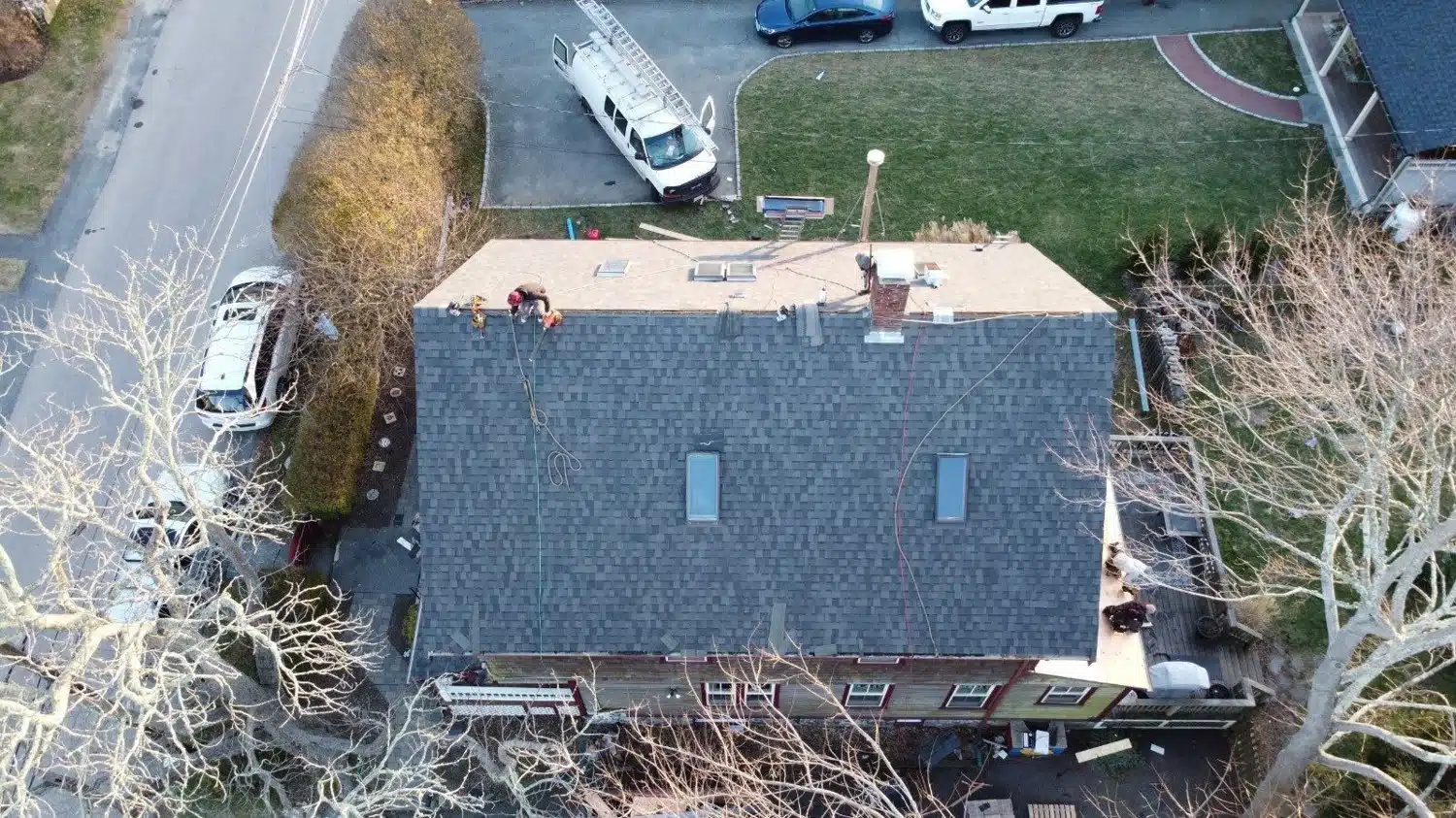

On Conanicut Island, a roof lives in the wind. That raises a fair question about ventilation: if a roof needs an opening at its peak to breathe, does that opening become a weak point when the wind really blows? On this Jamestown home the answer was engineered in — a baffled ridge vent built to shed wind-driven rain, paired with a heavier-weight CertainTeed Landmark PRO roof in Pewterwood rated for high winds. The home gets an attic that breathes and a roof that holds. Pinnacle roofs go on fast — often as a one-day roof replacement — and flexible financing keeps a project like this within reach, with plans as low as 0% interest for 18 months.
A Jamestown home was re-roofed in heavier-weight CertainTeed Landmark PRO in Pewterwood over a baffled, wind-resistant ridge-and-soffit ventilation system built for the island’s exposure. This project is in Jamestown, Rhode Island, finished in CertainTeed Landmark PRO — Pewterwood.
Scope of Work
Building a roof for an exposed island site means detailing every edge and opening for wind. Ventilation was set up as a balanced system — intake at the eave soffits and a continuous, externally-baffled ridge vent at the peak, the baffle being the feature that lets the vent exhaust air while deflecting wind-driven rain away from the opening. The waterproofing was built to match the exposure: CertainTeed WinterGuard ice-and-water shield along the eaves and up the valleys, DiamondDeck synthetic underlayment across the field, and new drip edge and starter courses locked down against uplift. The Landmark PRO shingles in Pewterwood were fastened with a high-wind nailing pattern for real resistance to the wind that tracks up Narragansett Bay, and coursed up the slopes to a clean ridge line capped over the baffled vent. The finished roof breathes at the peak and holds at the edges — the combination an island roof needs.
What We Installed (And Why)
A roof on open water asks more of both the shingle and the ventilation, and this build answered on both counts. CertainTeed Landmark PRO is the heavier-weight member of the Landmark family — a dual-layer architectural shingle with more mass than the standard Landmark, rated to 130 mph winds, carrying a Class A fire rating, Max Def color depth, and StreakFighter algae resistance, and installed to a specification that qualifies for CertainTeed’s strongest SureStart PLUS warranty coverage. Its Pewterwood color is a cool, silvery-gray blend with real shadow depth. The heavier weight and the 130 mph rating matter on Jamestown, where the wind off the bay tests a roof constantly. But the question an island roof raises is about the ventilation: a ridge vent is an opening along the peak, and homeowners rightly wonder whether wind will drive rain through it. The answer is the externally-baffled ridge vent — a vent with a built-in baffle that creates a low-pressure zone as wind passes over it, actively pulling air out of the attic while deflecting wind-driven rain and snow away from the opening. Paired with open soffit intake at the eaves, it delivers the balanced airflow that keeps the attic cool in summer and dry in winter, and it does so without becoming the weak point in a high-wind roof. On an island, ventilation and wind resistance are not a trade-off — with the right baffled vent and a high-wind shingle, you get both.
Project Photo Gallery


Good To Know: Can a ridge vent handle the wind on an island like Jamestown?
Yes — provided it is the right kind of ridge vent. The concern is reasonable: a ridge vent is a continuous opening along the peak of the roof, and on an exposed site like Jamestown you do not want wind driving rain in through it. The solution is an externally-baffled ridge vent. The baffle is a raised lip along the vent that changes how wind behaves as it passes over the ridge: instead of blowing into the opening, the wind is lifted over the baffle, which creates a zone of low pressure that actually pulls air up and out of the attic — so high wind makes the vent exhaust harder, not leak. The same baffle deflects wind-driven rain and snow away from the opening. Combined with open soffit intake at the eaves, it gives an island home the balanced ventilation it needs without creating a vulnerability in a high-wind roof. The failures people have heard about almost always involve older, un-baffled vents or box vents poorly placed on an exposed roof. A properly baffled ridge vent, paired with a high-wind shingle like Landmark PRO, is built for exactly the conditions Jamestown delivers.
Why This Approach Works
On an exposed island roof, every opening has to earn its place, and the ridge vent is no exception. An externally-baffled ridge vent turns the wind to the roof’s advantage — using it to pull air out while deflecting rain away — so the attic gets the ventilation it needs without the peak becoming a weak point. Paired with a high-wind shingle, it is how a roof breathes and holds at the same time.
Why Pinnacle
Building a roof that both breathes and stands up to island wind rewards a contractor who details the ventilation and the high-wind fastening to specification. As a CertainTeed ShingleMaster™ Premier contractor, Pinnacle qualifies our customers for CertainTeed’s full SureStart™ PLUS extended warranty — coverage most contractors cannot offer. We’ve served Rhode Island since 2012, hold a 5.0-star Google rating across 100+ reviews and an A+ BBB rating — see our full credentials.
Jamestown, Rhode Island
Jamestown occupies Conanicut Island in the middle of Narragansett Bay, ringed by open water and exposed to wind from nearly every direction. That exposure shapes everything about a good roof here: edges and fasteners detailed against uplift, a high-wind shingle, and ventilation that works with the wind instead of being undone by it. A Landmark PRO roof over a baffled, balanced ventilation system is built for the way weather actually arrives on the island — from the water, hard, and from all sides. Explore our work across Jamestown roofing services.
Need a roofing estimate in Jamestown? Use our instant estimate tool, book a free appointment, or call us today.
Exploring payment options? Ask about financing — plans as low as 0% interest for 18 months.
401-267-ROOF (7663)
Frequently Asked Questions
Will a ridge vent leak in high wind?
Not if it is an externally-baffled ridge vent. The baffle is a raised lip that lifts wind up and over the opening, creating low pressure that pulls air out of the attic while deflecting wind-driven rain away. High wind actually makes a baffled vent exhaust harder rather than leak. The leaks people have heard about typically involve older un-baffled vents or poorly placed box vents, which is why we use a baffled ridge vent on exposed sites.
Why use Landmark PRO instead of standard Landmark on an island?
Landmark PRO is the heavier-weight version of the shingle, with more mass, a 130 mph wind rating, and eligibility for CertainTeed’s strongest SureStart PLUS warranty when installed to specification. On an exposed island site like Jamestown, where wind off the bay tests the roof constantly, the extra weight and higher wind rating are worth it.
Do I have to choose between ventilation and wind resistance?
No. With the right components you get both. An externally-baffled ridge vent provides the exhaust an attic needs while resisting wind-driven rain, open soffit vents supply the intake, and a high-wind shingle fastened with a proper nailing pattern handles the uplift. Built together, ventilation and wind resistance reinforce each other rather than trading off.
More Resources for Jamestown
- Jamestown Roofing Services
- Residential Roofing
- CertainTeed Shingles
- Residential Roofing
- One-Day Roof Replacement
- Financing Available
- Instant Roof Estimate
- Showcase Gallery
Browse more of our Rhode Island project galleries:
Explore all Rhode Island Roofing Projects →Explore all CertainTeed Shingle Projects →