
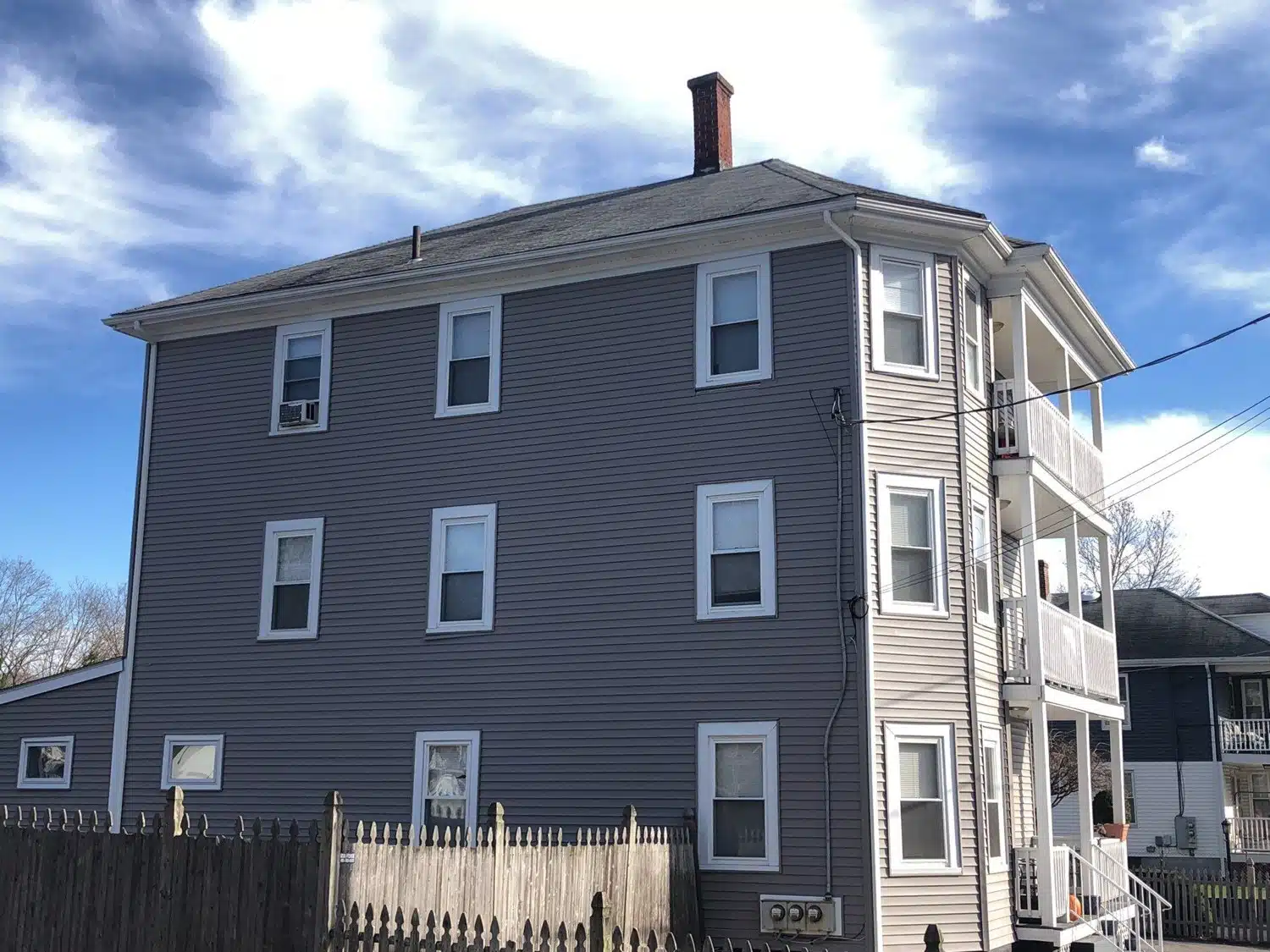

In Lincoln, the roofing problem that costs homeowners the most does not arrive with a storm — it forms quietly in winter, when a warm attic melts the snow on the roof and the runoff refreezes into an ice dam at the cold eaves. This multi-family home got the two-part defense that actually works against it: a balanced ventilation system that keeps the roof deck cold and even, and a new CertainTeed Landmark roof in Pewterwood built over ice-and-water protection at the vulnerable edges. Pinnacle roofs go on fast — often as a one-day roof replacement — and flexible financing keeps a project like this within reach, with plans as low as 0% interest for 18 months.
A Lincoln multi-family home was re-roofed in CertainTeed Landmark Pewterwood over a balanced ventilation system and ice-and-water shield, the combination that defends against winter ice dams. This project is in Lincoln, Rhode Island, finished in CertainTeed Landmark — Pewterwood.
Scope of Work
Opening the roof revealed what a warm, under-ventilated attic does over a New England winter: signs of past moisture on the underside of the deck, where heat escaping from the living space had melted snow above and let the runoff work back under the shingles. The rebuild addressed both halves of the problem. First, ventilation: intake was confirmed at the eaves and a continuous ridge vent installed at the peak, so cold outside air washes the underside of the deck and keeps it near the outdoor temperature — the key to stopping the melt-refreeze cycle that builds an ice dam. Second, the edges: CertainTeed WinterGuard ice-and-water shield was run along all the eaves, extending up the slope past the interior wall line so that even if an ice dam does form, the water backing up behind it meets a waterproof membrane instead of open deck. DiamondDeck synthetic underlayment covered the field, new drip edge locked the edges, and the Landmark shingles in Pewterwood were coursed up the tall slopes of the three-story home and capped over the ridge vent. On a multi-family building where a single leak affects more than one unit, that layered defense matters even more.
What We Installed (And Why)
This roof pairs a proven shingle with the airflow and edge protection that a Rhode Island winter demands. CertainTeed Landmark is a dual-layer, fiberglass-based architectural shingle with a Class A fire rating and StreakFighter algae-resistant granules, and its Pewterwood color is a cool, silvery-gray blend that suits the tall, upright lines of a New England triple-decker. But the shingle is not what stops an ice dam — ventilation and ice-and-water membrane are. Here is the mechanism: in winter, heat leaking from the living space warms the attic, which warms the roof deck, which melts the underside of the snow pack on the roof. That meltwater runs down the slope until it reaches the eaves — which hang out over open air and stay cold — where it refreezes into a ridge of ice. As the dam grows, it traps more meltwater behind it, and that standing water backs up under the shingles and into the house. A balanced ridge-and-soffit ventilation system breaks the cycle at its source: by flushing the attic with cold outdoor air, it keeps the whole deck near the outside temperature, so the snow does not melt unevenly in the first place. The WinterGuard membrane at the eaves is the backup — a waterproof barrier that keeps any water that does back up from reaching the deck. Together, ventilation and ice-and-water shield are the real ice-dam defense, and Landmark is the durable, good-looking roof that goes on top of it.
Project Photo Gallery


Good To Know: How does roof ventilation help prevent ice dams?
Ice dams form because a roof melts unevenly in winter. Heat escaping from the living space warms the attic and the roof deck, which melts the snow sitting on the upper roof; that meltwater runs down to the eaves, which overhang cold open air, and there it refreezes into a dam of ice. The growing dam traps more meltwater behind it, and that pooled water backs up under the shingles and leaks into the house. The root cause is a warm, unevenly heated roof deck — and that is exactly what ventilation fixes. A balanced ridge-and-soffit system continuously washes the underside of the deck with cold outdoor air, keeping the whole roof surface close to the outside temperature so the snow does not melt at the top and refreeze at the eaves. Pair that with ice-and-water shield membrane run along the eaves as a waterproof backup, and you have addressed both the cause and the consequence. This is why we treat ventilation and edge membrane as the ice-dam defense — not a thicker shingle, which does nothing to stop the melt-refreeze cycle that creates the dam in the first place.
Why This Approach Works
Ice dams are a heat problem before they are a water problem, so the fix starts with keeping the roof deck cold and even — the job of balanced ventilation — and finishes with a waterproof membrane at the eaves to stop any water that does back up. Building both into the roof is what protects a home, and on a multi-family building it protects several at once.
Why Pinnacle
Defending a roof against ice dams takes a contractor who builds ventilation and edge protection as a system, not an afterthought. As a CertainTeed ShingleMaster™ Premier contractor, Pinnacle qualifies our customers for CertainTeed’s full SureStart™ PLUS extended warranty — coverage most contractors cannot offer. We’ve served Rhode Island since 2012, hold a 5.0-star Google rating across 100+ reviews and an A+ BBB rating — see our full credentials.
Lincoln, Rhode Island
Lincoln is a northern Rhode Island town of established neighborhoods, historic mill villages, and a good stock of multi-family homes, and it sits far enough inland to get the full brunt of the region’s winters. That makes ice dams a real and recurring threat here — the kind of problem that shows up as a stained ceiling in February and traces straight back to attic heat and poor ventilation. A roof built the way this one was, with balanced airflow and ice-and-water protection at the eaves, is the durable answer to a Lincoln winter. Explore our work across Lincoln roofing services.
Need a roofing estimate in Lincoln? Use our instant estimate tool, book a free appointment, or call us today.
Exploring payment options? Ask about financing — plans as low as 0% interest for 18 months.
401-267-ROOF (7663)
Frequently Asked Questions
What causes ice dams on a roof?
A warm, unevenly heated roof. Heat escaping into the attic melts the snow on the upper roof, the meltwater runs down to the cold overhanging eaves and refreezes into a ridge of ice, and that dam traps more water behind it until it backs up under the shingles and leaks inside. The underlying cause is a warm attic and poor ventilation, not the shingles themselves.
Can better ventilation really stop ice dams?
It addresses the root cause. A balanced ridge-and-soffit ventilation system flushes the attic with cold outdoor air and keeps the whole roof deck near the outside temperature, so the snow does not melt at the top and refreeze at the eaves. Combined with ice-and-water shield membrane run along the eaves as a waterproof backup, it is the most effective defense against ice dams a re-roof can build in.
Why does ice-and-water shield go along the eaves?
Because the eaves are where ice dams form and where backed-up water tries to enter. Running a self-sealing waterproof membrane along the eaves — extending up the slope past the interior wall line — means that even if a dam forms, the water pooling behind it meets a waterproof barrier instead of bare deck, keeping it out of the house. It is the backup that works alongside ventilation.
More Resources for Lincoln
- Lincoln Roofing Services
- Residential Roofing
- CertainTeed Shingles
- Residential Roofing
- One-Day Roof Replacement
- Financing Available
- Instant Roof Estimate
- Showcase Gallery
Browse more of our Rhode Island project galleries:
Explore all Rhode Island Roofing Projects →Explore all CertainTeed Shingle Projects →