
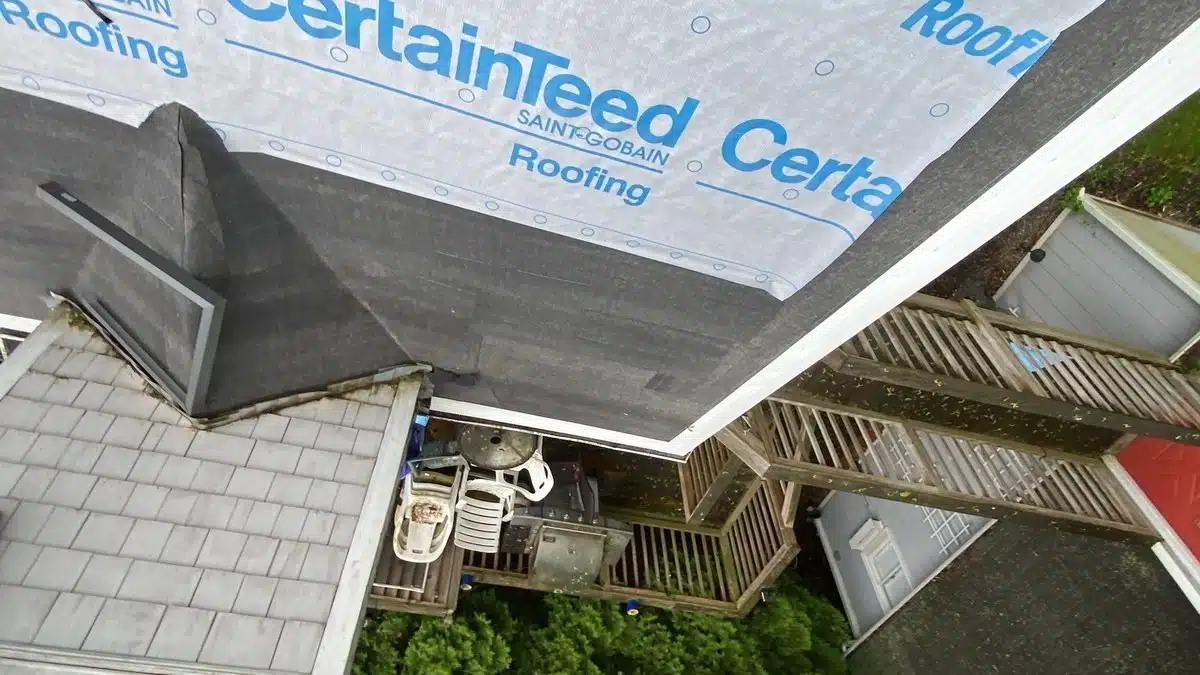

Almost everyone has heard that skylights leak. What far fewer people know is why — and that the reason has almost nothing to do with the glass. This Narragansett home got new VELUX skylights set into a new CertainTeed Landmark roof in Pewterwood, installed the way that actually keeps a skylight dry: with engineered metal flashing, not a bead of caulk. Pinnacle roofs go on fast — often as a one-day roof replacement — and flexible financing keeps a project like this within reach, with plans as low as 0% interest for 18 months.
A Narragansett home had new VELUX skylights installed into a new CertainTeed Landmark roof in Pewterwood, each sealed with its engineered metal flashing kit — the layered flashing, not sealant, that keeps a skylight watertight. This project is in Narragansett, Rhode Island, finished in CertainTeed Landmark — Pewterwood.
Scope of Work
The work centered on the connection that decides whether a skylight leaks: the flashing where the unit meets the roof. The steep slopes were built up with the full weather system — ice-and-water shield at the eaves and valleys, synthetic underlayment, and new drip edge and starter — and coursed in Landmark shingles in Pewterwood. Each VELUX skylight was set on its curb and flashed with the engineered metal flashing kit matched to the roof covering: a sill piece at the bottom, step flashing woven up the sides between the shingle courses, and a head piece at the top, with ice-and-water membrane lapped up the curb beneath it all. That layered metal — not sealant — is what carries water over, around, and past the skylight and back onto the roof. Installed as part of the new roof, the skylights became a sealed part of the system from the first rain.
What We Installed (And Why)
Understanding why skylights leak is the key to this whole project. An old or badly-installed skylight almost never leaks through the glass or the seals of the unit itself — it leaks at the perimeter, where the skylight meets the roof, and it leaks there because someone relied on caulk to bridge that gap. Sealant is a surface patch, not a waterproofing system: it dries, cracks, and lets water in, usually within a season or two, and then the leak gets blamed on the skylight. The real solution is the same one that keeps a roof valley or a chimney dry — layered metal flashing that directs water by gravity. VELUX sells its units as No Leak Skylights precisely because each one ships with a flashing kit engineered to the exact roof covering, so the installer builds a sill, step, and head flashing assembly that laps into the shingle courses and carries water around the unit without a drop of caulk doing the real work. The shingle here is CertainTeed Landmark in Pewterwood — the dual-layer architectural shingle that set the standard, with a Class A fire rating and StreakFighter algae resistance, in a weathered gray-and-brown blend that suits a coastal New England home. But the shingle is not what makes the skylights dry; the flashing is. Installing new VELUX units with their engineered flashing into a new Landmark roof is what turns the skylight from the thing people fear will leak into one of the most reliably watertight parts of the roof.
Project Photo Gallery


Good To Know: Why do old skylights leak, and do new ones still?
Old skylights leak almost entirely because of how they were flashed — or weren’t. The leak rarely comes through the glass or the factory seals; it comes in at the edges, where the skylight meets the roof, and it comes in because that joint was sealed with caulk instead of flashed with metal. Caulk is a temporary surface patch: it dries out, cracks, and separates, and once it does, water runs straight past it into the roof, where it shows up as a stain on the ceiling and gets blamed on the skylight. Modern skylights, installed correctly, do not have this problem. VELUX units are sold as No Leak Skylights because each ships with an engineered metal flashing kit — a sill piece, step flashing up the sides, and a head piece — that laps into the shingle courses and carries water over and around the unit the same way a properly built valley or chimney flashing does. There is no caulk holding back the weather; the layered metal does the work, and metal does not dry out and crack the way sealant does. So a new skylight, flashed with its engineered kit into a sound roof, is genuinely reliable — it is the caulk-and-hope installations of decades past that gave skylights their leaky reputation. On this Narragansett home, replacing the approach as much as the units — engineered flashing instead of sealant, installed into a new roof — is what makes these skylights dependable.
Why This Approach Works
Skylights leak at the perimeter, not the glass, and they leak because the joint to the roof was caulked instead of flashed. Installing VELUX units with their engineered metal flashing — sill, step, and head pieces lapped into the shingles — carries water around the unit the way a valley does, which is what actually keeps a skylight dry.
Why Pinnacle
Skylight work rewards a contractor who flashes each unit with its engineered metal kit into the shingle courses rather than relying on sealant, so the skylight is as watertight as any other part of the roof. As a VELUX 5-Star Skylight Specialist and CertainTeed ShingleMaster™, Pinnacle qualifies our customers for CertainTeed’s full SureStart™ PLUS extended warranty — coverage most contractors cannot offer. We’ve served Rhode Island since 2012, hold a 5.0-star Google rating across 100+ reviews and an A+ BBB rating — see our full credentials.
Narragansett, Rhode Island
Narragansett is a classic Rhode Island shore town, its neighborhoods running from the seawall and the Towers down through summer cottages and year-round homes. Salt air and coastal weather test every joint on a roof, which makes the difference between a caulked skylight and a properly flashed one especially stark here — sealant fails even faster in a marine climate. New VELUX skylights flashed with engineered metal into a Landmark roof are well suited to how hard the Narragansett coast is on a roof. Explore our work across Narragansett roofing services.
Need a roofing estimate in Narragansett? Use our instant estimate tool, book a free appointment, or call us today.
Exploring payment options? Ask about financing — plans as low as 0% interest for 18 months.
401-267-ROOF (7663)
Frequently Asked Questions
Is it the glass or the flashing that makes a skylight leak?
Almost always the flashing. A skylight’s glass and factory seals rarely fail; leaks come in at the perimeter where the unit meets the roof. When that joint is sealed with caulk instead of engineered metal flashing, it fails within a season or two and water gets past it. Proper metal flashing, lapped into the shingle courses, is what keeps a skylight dry.
What is CertainTeed Landmark Pewterwood?
CertainTeed Landmark is a dual-layer, fiberglass-based architectural shingle with a Class A fire rating and StreakFighter algae resistance. Pewterwood is a weathered gray-and-brown wood-tone blend that gives a roof a warm, established look and suits both traditional and coastal homes.
Can old leaking skylights be replaced without redoing the roof?
Often yes, if the surrounding roof is sound — the key is to replace the unit and, critically, re-flash it with an engineered metal kit rather than re-caulking. That said, if the roof is near the end of its life, replacing the skylights during a re-roof is the most reliable path, because the new flashing integrates into new shingles as one system, exactly as on this Narragansett home.
More Resources for Narragansett
- Narragansett Roofing Services
- VELUX Skylights
- CertainTeed Shingles
- Residential Roofing
- One-Day Roof Replacement
- Financing Available
- Instant Roof Estimate
- Showcase Gallery
Browse more of our Rhode Island project galleries:
Explore all Rhode Island Skylight Projects →Explore all VELUX Skylight & Sun Tunnel Projects →Explore all CertainTeed Shingle Projects →