
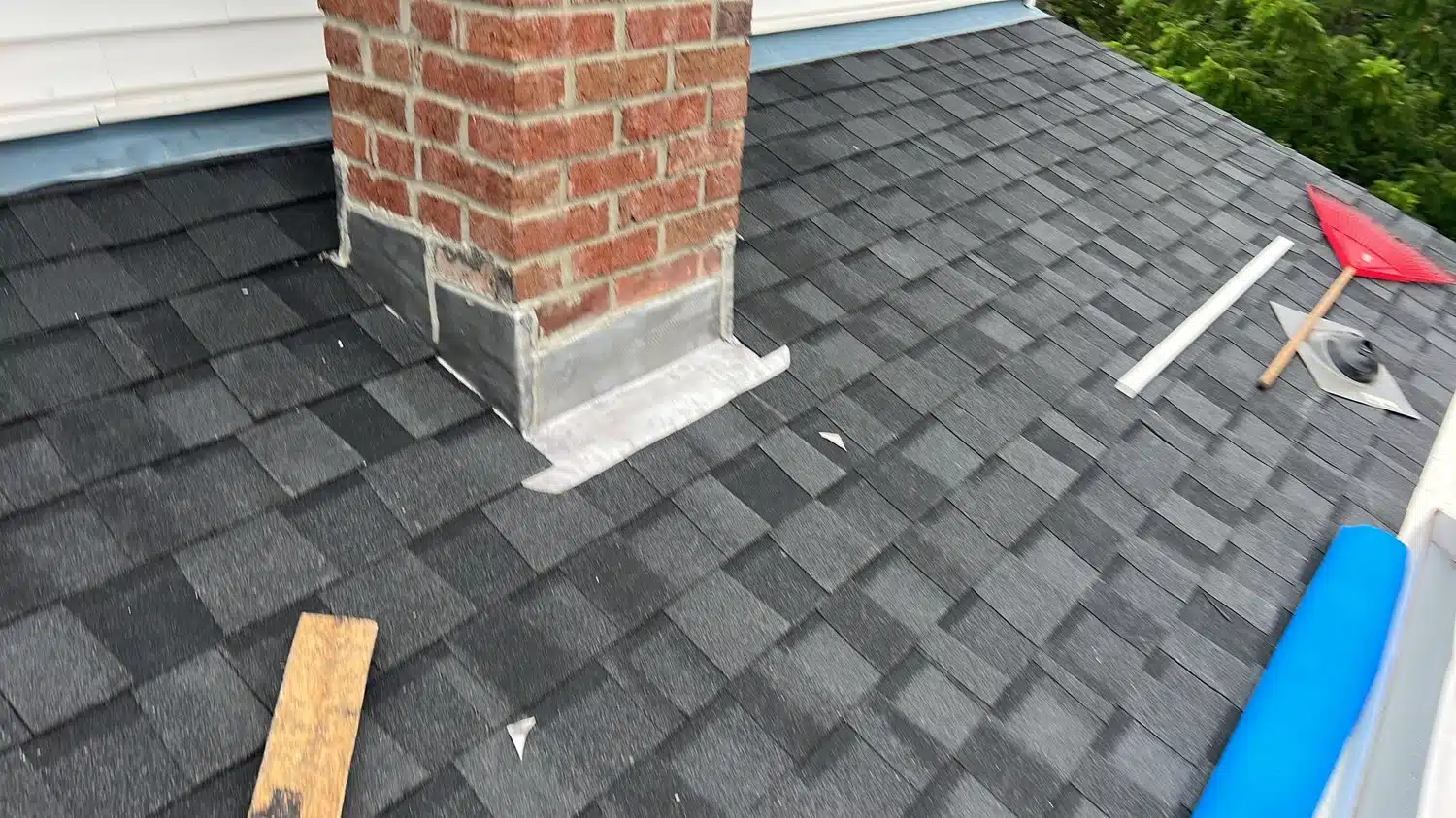

Most people think of roof ventilation as a summer concern — letting heat out of a hot attic. But ventilation does some of its most important work in winter, when a poorly-ventilated attic quietly fills with moisture and sets up the conditions for rotted sheathing and ice dams. This Richmond home got a new CertainTeed Northgate ClimateFlex roof in Moire Black, with a white EPDM section, built over a balanced ventilation system that keeps the attic dry through a Rhode Island winter. Pinnacle roofs go on fast — often as a one-day roof replacement — and flexible financing keeps a project like this within reach, with plans as low as 0% interest for 18 months.
A Richmond home was re-roofed in CertainTeed Northgate ClimateFlex impact-resistant shingles in Moire Black, with a white EPDM low-slope section, over a balanced ridge-and-soffit ventilation system built to keep the attic dry and free of ice dams through winter. This project is in Richmond, Rhode Island using CertainTeed Northgate ClimateFlex — Moire Black.
Scope of Work
The re-roof was built as a system, starting with the ventilation that protects it in the cold months. Intake was confirmed at the soffits and a continuous ridge vent set at the peak, establishing the balanced airflow that keeps the attic near outdoor temperature all winter. The weather system went down next — ice-and-water shield along the eaves and valleys (the first line of defense against ice dams), synthetic underlayment, and new drip edge and starter. The steep slopes were coursed in Northgate ClimateFlex shingles in Moire Black, a deep near-black; the home’s low-slope section was covered in a white EPDM rubber membrane; and the chimney was flashed where it passes through the roof. Finished with ridge caps over the ridge vent, the roof is set up so warm, moist indoor air cannot linger in the attic and freeze against the deck.
What We Installed (And Why)
This roof pairs an unusually tough shingle with the ventilation that protects it through winter. CertainTeed Northgate ClimateFlex is an impact-resistant architectural shingle: it carries a Class 4 impact rating — the highest — thanks to an SBS ‘rubberized’ asphalt formulation that stays flexible in the cold and resists cracking from hail and impact, and it holds a Class A fire rating, here in a deep Moire Black. On the low-slope section, a white EPDM rubber membrane sheds water where the pitch is too shallow for shingles. But the component that decides how the roof fares in a Rhode Island winter is the ventilation, and its winter job is the one people forget. All winter, a house pushes warm, humid air upward from cooking, showering, and heating. If the attic cannot breathe, that moisture condenses on the cold underside of the roof deck — frost that melts and soaks the sheathing, rotting it and ruining insulation over time. Worse, a warm attic melts the snow on the roof from below; the meltwater runs down to the cold eaves and refreezes into an ice dam that backs water up under the shingles and into the house. A balanced ridge-and-soffit ventilation system prevents both by keeping the attic cold and dry: intake at the eaves and exhaust at the ridge flush out the moist air before it can condense, and a cold roof deck means the snow does not melt and refreeze into dams. Paired with the ice-and-water shield along the eaves as a backup, the ventilation is what carries this roof safely through the season most likely to damage it.
Project Photo Gallery


Good To Know: How does roof ventilation prevent ice dams?
Ice dams form because of heat escaping into the attic, and ventilation is what removes that heat before it can do damage. Here is the sequence: in winter, warm air leaks up into the attic and, if the attic is poorly ventilated, it warms the roof deck. Snow sitting on that warm deck melts from underneath, and the meltwater trickles down the roof until it reaches the eaves — which overhang the exterior wall and stay cold. There the water refreezes, and as the cycle repeats it builds a ridge of ice, an ice dam, that traps more meltwater behind it. That trapped water has nowhere to go but sideways and up, backing under the shingles and leaking into the ceilings and walls below. A balanced ridge-and-soffit ventilation system breaks this cycle at its root by keeping the roof deck cold: cool outside air enters at the soffits and exhausts at the ridge, flushing away the heat that would otherwise melt the snow. A cold deck means the snow stays frozen and simply melts off gradually in the sun instead of refreezing at the eaves. Combined with a proper ice-and-water shield membrane along the eaves as a backup barrier, good ventilation is the real, permanent fix for ice dams — far more effective than chipping ice or running heat cables every winter.
Why This Approach Works
A poorly ventilated attic causes winter damage two ways: moist indoor air condenses on the cold deck and rots it, and escaping heat melts snow that refreezes into ice dams at the eaves. A balanced ridge-and-soffit system keeps the attic cold and dry, preventing both at the source.
Why Pinnacle
Winter roof problems reward a contractor who builds the ventilation to keep the attic cold and dry, so condensation and ice dams never get started. As a CertainTeed ShingleMaster™ Premier contractor, Pinnacle qualifies our customers for CertainTeed’s full SureStart™ PLUS extended warranty — coverage most contractors cannot offer. We’ve served Rhode Island since 2012, hold a 5.0-star Google rating across 100+ reviews and an A+ BBB rating — see our full credentials.
Richmond, Rhode Island
Richmond is a rural, wooded town in southern Rhode Island of open lots and older homes that take the region’s winters head-on. Cold, snowy stretches are exactly when a poorly ventilated roof reveals itself — through attic frost, damp insulation, and ice dams at the eaves. A balanced ventilation system, paired with a tough impact-resistant shingle like Northgate ClimateFlex, is well suited to how Richmond homes weather a Rhode Island winter. Explore our work across Richmond roofing services.
Need a roofing estimate in Richmond? Use our instant estimate tool, book a free appointment, or call us today.
Exploring payment options? Ask about financing — plans as low as 0% interest for 18 months.
401-267-ROOF (7663)
Frequently Asked Questions
What is CertainTeed Northgate ClimateFlex?
Northgate ClimateFlex is CertainTeed’s impact-resistant architectural shingle. It carries a Class 4 impact rating — the highest available — because it uses an SBS ‘rubberized’ asphalt that stays flexible and resists cracking from hail and impact, and it also has a Class A fire rating. On top of the durability, its rubberized formulation holds up especially well to the cold and thermal cycling of a New England winter.
Does attic ventilation really matter in winter?
Yes — arguably more than in summer. In winter a poorly ventilated attic traps the warm, moist air that rises from the house; that moisture condenses as frost on the cold roof deck and, over time, rots the sheathing and soaks the insulation. The same trapped heat melts roof snow that refreezes into ice dams at the eaves. Balanced ventilation keeps the attic cold and dry, preventing both problems at their source.
Can a new roof fix my ice dam problem?
It can, if the roof is built to address the cause rather than just the symptom. Ice dams come from a warm attic melting snow that refreezes at the cold eaves, so the durable fix is balanced ridge-and-soffit ventilation that keeps the deck cold, backed by an ice-and-water shield membrane along the eaves as a secondary barrier. A re-roof that includes both — as this Richmond project did — addresses ice dams far more permanently than heat cables or seasonal ice removal.
More Resources for Richmond
- Richmond Roofing Services
- Residential Roofing
- CertainTeed Shingles
- Residential Roofing
- One-Day Roof Replacement
- Financing Available
- Instant Roof Estimate
- Showcase Gallery
Browse more of our Rhode Island project galleries:
Explore all Rhode Island Roofing Projects →Explore all CertainTeed Shingle Projects →