
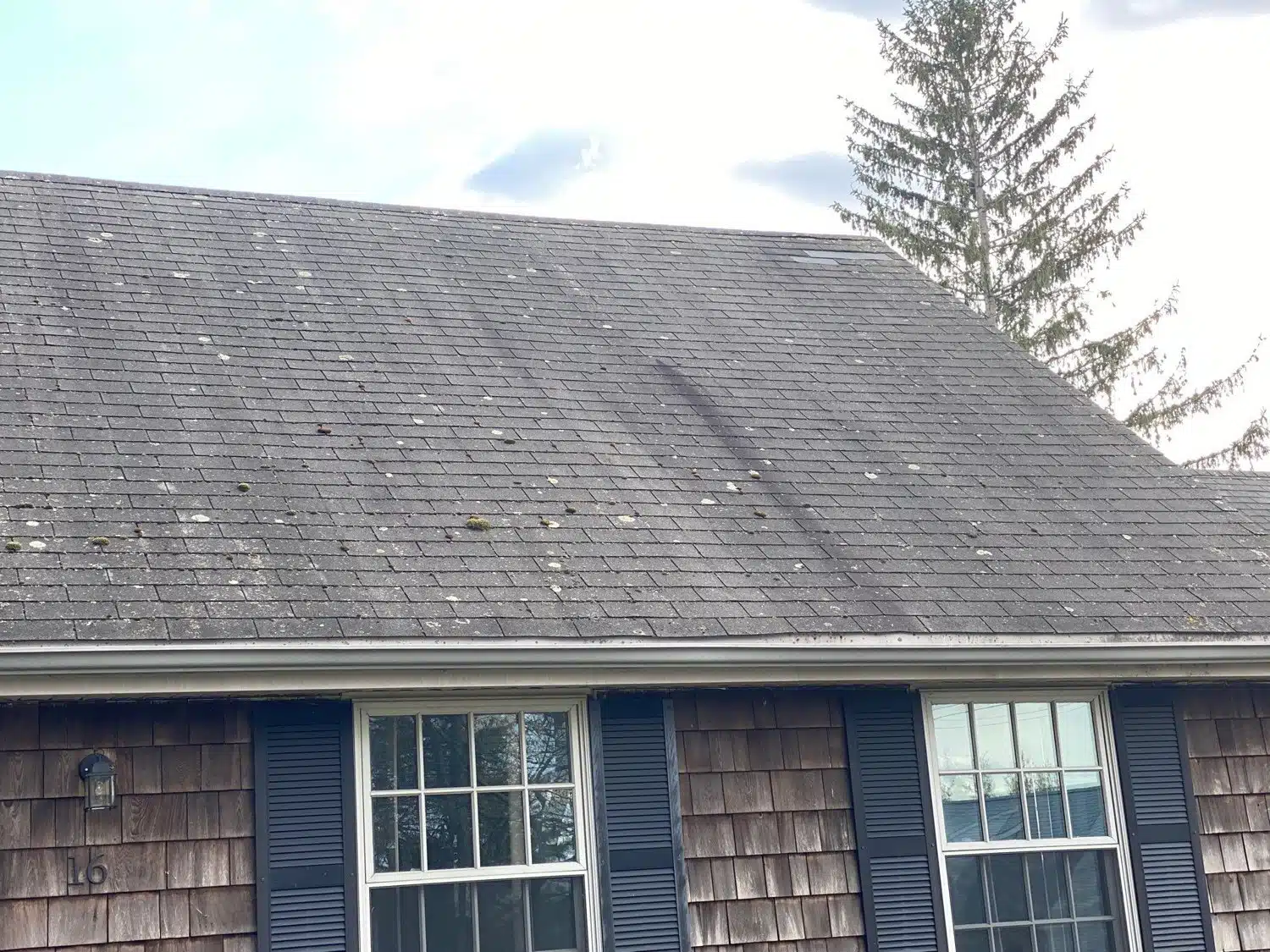

When wind and storm damage hits a home, it rarely stops at the roof — the same weather that tears at shingles drives rain and debris against the walls. This Smithfield home was restored as a whole exterior: new siding to close up and protect the walls, a new CertainTeed Landmark roof in Pewterwood overhead, and chimney work to seal the roof’s toughest penetration. Pinnacle roofs go on fast — often as a one-day roof replacement — and flexible financing keeps a project like this within reach, with plans as low as 0% interest for 18 months.
A Smithfield home damaged by a wind storm was restored with new siding, a new CertainTeed Landmark roof in Pewterwood, and chimney work — treating the roof and walls as one weather envelope rather than separate repairs. This project is in Smithfield, Rhode Island using new siding.
Scope of Work
Storm damage to a home is rarely confined to one surface, so this project addressed the exterior as a system. New siding was installed to close up and weatherproof the walls, restoring both the home’s protection and its appearance where wind and driven rain had done their damage. Overhead, a new CertainTeed Landmark roof in Pewterwood went on with the full weather system beneath it — ice-and-water shield, underlayment, and new edge metal — and the chimney, always one of the most leak-prone spots on any roof, was addressed with proper flashing so the roof-to-masonry junction is sealed. Doing the siding, roof, and chimney together meant every part of the home’s weather envelope was brought back to full integrity at once, with the transitions between roof and wall handled as part of one job rather than left as seams between separate repairs.
What We Installed (And Why)
A home’s exterior is a single weather envelope — roof, walls, and the flashings that tie them together — and this restoration treated it that way. The siding is what protects and finishes the walls: installed over a sound wall surface, it sheds water, stands up to wind, and gives the home a clean, renewed exterior, closing up exactly the surfaces a storm exposes. Overhead, the roof is CertainTeed Landmark in Pewterwood, the dual-layer architectural shingle that set the standard — Class A fire rating, StreakFighter algae resistance, and real dimensional depth — in a weathered gray-and-brown wood-tone that pairs naturally with new siding for a coordinated exterior. The detail that ties it all together, and the one most often done poorly, is the chimney. A chimney interrupts the roof, and water wants to get in where the shingles meet the masonry; keeping it out takes proper step and counter flashing woven into the courses and set into the masonry, not a smear of sealant that fails in a season. Getting the chimney flashing right is what keeps the roof’s hardest penetration dry. Restoring siding, roof, and chimney together is what returns a storm-damaged home to a fully sealed, weather-tight envelope — rather than fixing one surface and leaving the next storm a way in.
Project Photo Gallery


Good To Know: Why does storm damage so often affect both the roof and the siding?
Because the same storm that damages a roof is working on the whole house at once. High wind does not only lift and tear shingles — it drives rain horizontally against the walls, throws branches and debris into the siding, and forces water into any seam or gap it can find on any surface of the home. So a storm that damages the roof has very often loosened, cracked, or torn siding as well, even if the roof damage is what first gets noticed. Treating only the roof and leaving compromised siding means the walls are still exposed, and the next storm drives water straight into them — into the wall cavity, behind the remaining siding, and eventually to the interior. That is why the right approach to storm damage is to look at the entire weather envelope: the roof, the walls, and the flashings and transitions that join them, including vulnerable points like the chimney. Restoring all of it together, as on this Smithfield home, returns the house to a single sealed exterior with no weak surface left for the weather to exploit. It is also the more efficient path when storm damage is being handled — addressing the roof, siding, and chimney as one project rather than discovering the wall damage after the roof is already done.
Why This Approach Works
A home’s exterior is one weather envelope, and a storm works on all of it — roof, walls, and the flashings between them — at once. Restoring the siding, roof, and chimney together returns the whole envelope to integrity, rather than sealing one surface and leaving the next storm a way in.
Why Pinnacle
Whole-exterior storm restoration rewards a contractor who handles roof, siding, and flashing details together, so every transition between surfaces is sealed as part of one coordinated job. Pinnacle installs as a siding and exterior specialist and CertainTeed ShingleMaster™, to the manufacturer’s specification. We’ve served Rhode Island since 2012, hold a 5.0-star Google rating across 100+ reviews and an A+ BBB rating — see our full credentials.
Smithfield, Rhode Island
Smithfield is a northern Rhode Island town of wooded neighborhoods, older homes, and open, exposed lots that catch the wind that rolls through the region’s storms. Homes here take weather on every surface, and wind-driven storm damage to both roofs and siding is a familiar problem. Restoring the full exterior — siding, roof, and chimney — as one weather-tight envelope suits the kind of homes Smithfield has and the storms they weather. Explore our work across Smithfield roofing services.
Need a roofing estimate in Smithfield? Use our instant estimate tool, book a free appointment, or call us today.
Exploring payment options? Ask about financing — plans as low as 0% interest for 18 months.
401-267-ROOF (7663)
Frequently Asked Questions
Should I repair siding and roofing together after a storm?
Usually yes. Storms damage the whole exterior — wind tears at the roof while driven rain and debris work on the walls — so roof damage very often comes with siding damage. Restoring both together returns the home to one sealed weather envelope and avoids the common problem of fixing the roof only to find the walls still let water in during the next storm.
Why is chimney flashing such a common leak point?
Because a chimney interrupts the roof, and the junction between the shingles and the masonry is exactly where water wants to get in. Keeping it out requires proper step and counter flashing woven into the shingle courses and set into the masonry — not sealant, which fails within a season or two. Done correctly, the flashing keeps the roof’s hardest penetration watertight.
What roof shingle pairs well with new siding?
A dimensional architectural shingle in a versatile color coordinates best with fresh siding. CertainTeed Landmark in Pewterwood — a weathered gray-and-brown wood-tone with real depth — pairs naturally with a range of siding colors and gives the whole exterior a coordinated, finished look rather than a patched-together one.
More Resources for Smithfield
- Smithfield Roofing Services
- Residential Roofing
- Residential Roofing
- One-Day Roof Replacement
- Financing Available
- Instant Roof Estimate
- Showcase Gallery
Browse more of our Rhode Island project galleries:
Explore all Siding Projects →Explore all CertainTeed Shingle Projects →