
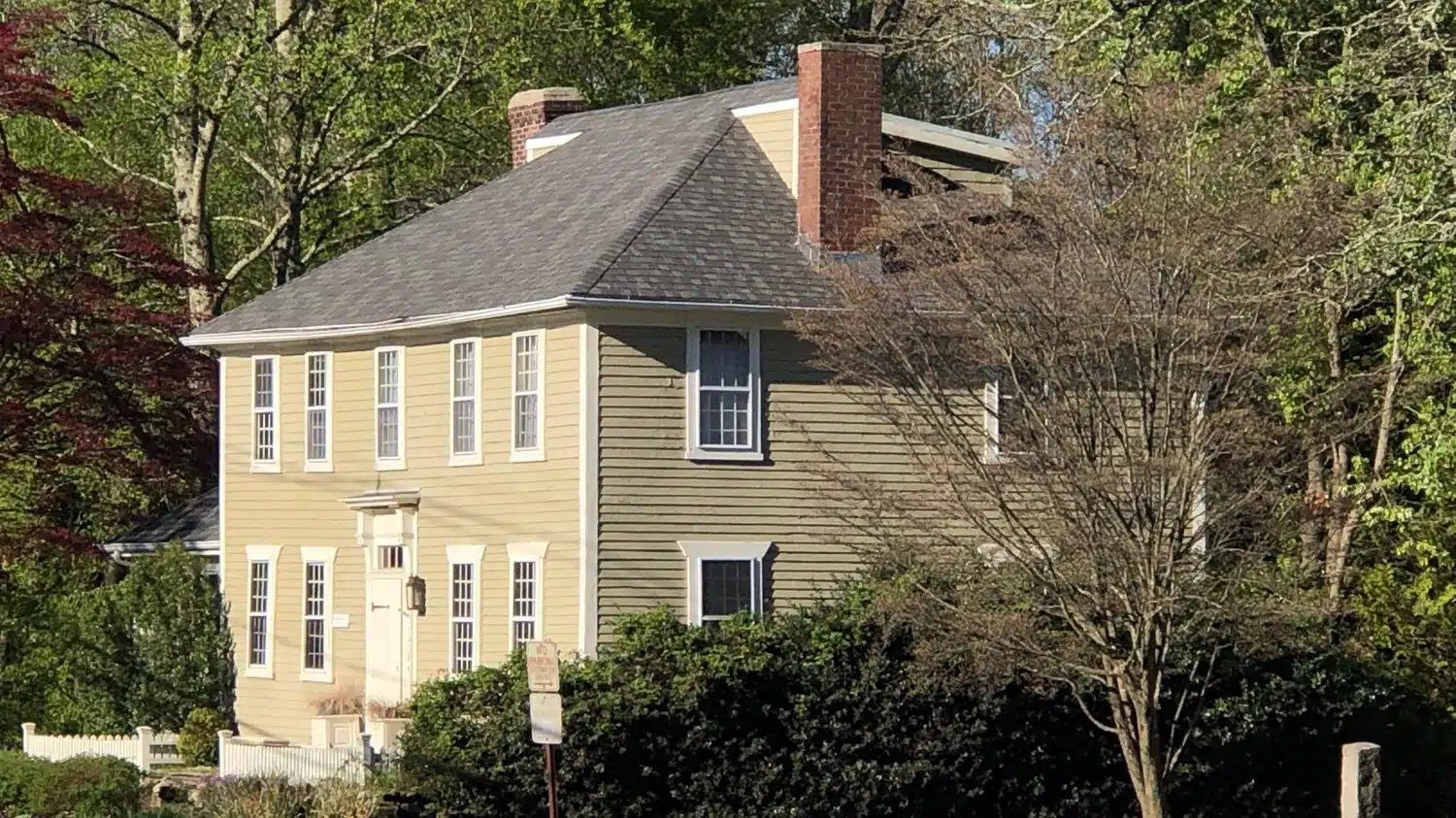

This home in the historic village of Kingston, part of South Kingstown, was built in 1820 — more than two hundred years ago — and re-roofing a house that old takes more than laying new shingles. The deck underneath had to be brought up to a modern standard first, and only then did the new CertainTeed Landmark roof in Driftwood go on: a warm, earthy color that suits a period home while protecting it for decades to come. Pinnacle roofs go on fast — often as a one-day roof replacement — and flexible financing keeps a project like this within reach, with plans as low as 0% interest for 18 months.
A more than 200-year-old home in Kingston (South Kingstown) was re-roofed in CertainTeed Landmark Driftwood over a new plywood deck installed on top of the original spaced sheathing boards, meeting building code and manufacturer specifications for a solid, securely fastened roof. This project is in South Kingstown, Rhode Island, finished in CertainTeed Landmark — Driftwood.
Scope of Work
On a house from 1820, the roof deck is often the original spaced sheathing — individual boards laid with gaps between them, the way roofs were built long before plywood existed. Shingles cannot be securely and reliably fastened to that kind of gapped deck, so the first step here was to install new plywood decking over the old spaced sheathing boards, creating a solid, continuous surface to attach the roofing to. This is best practice and it is what building code and the shingle manufacturer’s specifications require. With a sound deck in place, the crew installed the full weather system — ice-and-water shield at the eaves and valleys, synthetic underlayment across the field, and new drip edge and starter courses — and then coursed up the CertainTeed Landmark shingles in Driftwood. The result respects the age of the home while giving it a roof built entirely to current standards.
What We Installed (And Why)
The shingle chosen for this historic home was CertainTeed Landmark in the Driftwood color, and the choice suits the house on both looks and performance. Landmark is a dual-layer, fiberglass-based architectural shingle with a Class A fire rating and StreakFighter algae-resistant granules — the dimensional shingle that made architectural roofing the standard, with the depth and shadow line that a flat three-tab strip could never give a period home. Driftwood is a blend of gray, brown, and subtle shades of tan; the overall effect is a warm, earthy tone that complements a wide range of architectural styles and gives a roof a classic, timeless look while blending naturally with its surroundings — exactly the quiet, settled appearance an old New England home wants rather than anything that looks brand-new and out of place. Underneath that good-looking shingle is the part that actually protects a 200-year-old house: the rebuilt deck. Installing new plywood over the original spaced sheathing gives every nail a solid, continuous surface to bite into, so the shingles are held down to the manufacturer’s fastening spec and the roof can stand up to Rhode Island’s wind and weather. On a home this old, getting the structure under the shingles right is what separates a roof that lasts from one that simply looks new for a season.
Project Photo Gallery


Good To Know: Why does an old home often need a new roof deck before shingles?
Because many older homes were built with spaced sheathing — individual roof boards nailed down with gaps between them, which was standard long before plywood and OSB existed. That gapped surface was fine for the wood shingles of the era, but modern asphalt shingles are engineered to be fastened to a solid, continuous deck. Nails driven into a gap hold nothing, and a shingle that is not fastened to the manufacturer’s specification can lift, leak, or void its warranty. Installing a new layer of plywood decking over the original boards — as we did on this 1820 Kingston home — creates the solid surface the new roof needs, meets current building code, and satisfies the shingle maker’s installation requirements. It also lets the crew find and address any soft or rotted original boards along the way. Skipping this step to save money is one of the most common mistakes on an older home, and it is exactly the kind of shortcut that shows up as loose or leaking shingles a few years later. On a house that has already stood for two centuries, it is worth building the new roof on a foundation that will let it protect the home for decades more.
Why This Approach Works
A roof is only as sound as the deck beneath it, and on a historic home that deck is often original spaced sheathing that modern shingles cannot be properly fastened to. Installing new plywood decking over the old boards first — to code and to manufacturer spec — is what lets a period home carry a durable, warrantable roof.
Why Pinnacle
Re-roofing a two-hundred-year-old home rewards a contractor who understands old construction and builds the deck to current standards before a single shingle goes on. As a CertainTeed ShingleMaster™ Premier contractor, Pinnacle qualifies our customers for CertainTeed’s full SureStart™ PLUS extended warranty — coverage most contractors cannot offer. We’ve served Rhode Island since 2012, hold a 5.0-star Google rating across 100+ reviews and an A+ BBB rating — see our full credentials.
South Kingstown, Rhode Island
Kingston is one of Rhode Island’s most historic villages, a National Register district within South Kingstown lined with Colonial and early-Republic homes, many dating to the 1700s and 1800s and set near the University of Rhode Island. Roofs on these houses ask for care that newer construction does not — original decking, older framing, and a look that has to sit right on a period home. A CertainTeed Landmark roof in a warm, traditional color, installed over a properly rebuilt deck, lets a historic Kingston home keep its character while gaining a roof built entirely to modern standards. Explore our work across South Kingstown roofing services.
Need a roofing estimate in South Kingstown? Use our instant estimate tool, book a free appointment, or call us today.
Exploring payment options? Ask about financing — plans as low as 0% interest for 18 months.
401-267-ROOF (7663)
Frequently Asked Questions
What color is CertainTeed Landmark Driftwood?
Driftwood is a blend of gray, brown, and subtle shades of tan that reads as a warm, earthy tone. It gives a roof a classic, timeless look and blends naturally with its surroundings, which is why it works so well on historic and traditional homes — it looks settled and appropriate rather than brand-new and stark against an older house.
Can you re-roof a historic home to modern standards without changing its character?
Yes. The goal is a roof that protects the home to current code while looking right for its age. That means rebuilding the deck and installing a full modern weather system underneath, then finishing with an architectural shingle in a traditional color — like Landmark Driftwood — whose depth and earthy tone suit a period home far better than a flat, modern-looking shingle would.
Do you have to tear off the old roof boards on an old house?
Usually not — the better approach is often to leave the sound original spaced sheathing in place and install new plywood decking over it. That preserves the existing structure, adds a solid continuous nailing surface for the new shingles, and brings the deck up to code and manufacturer spec. Any boards found to be rotted or soft are addressed, but the original framing and sheathing generally stay as part of the house’s history.
More Resources for South Kingstown
- South Kingstown Roofing Services
- Residential Roofing
- CertainTeed Shingles
- Residential Roofing
- One-Day Roof Replacement
- Financing Available
- Instant Roof Estimate
- Showcase Gallery
Browse more of our Rhode Island project galleries:
Explore all Rhode Island Roofing Projects →Explore all CertainTeed Shingle Projects →