
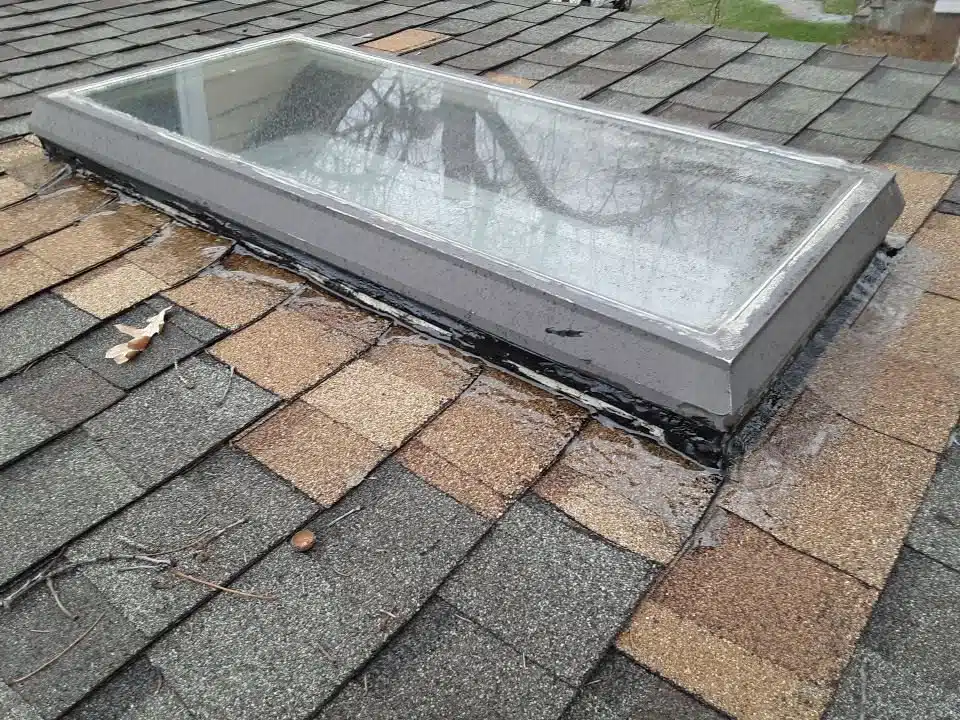

This Warwick home had a ceiling stain that would not go away and a skylight that sat on the part of the roof most likely to leak — the low-slope section where a steep roof steps down to a near-flat run. The fix was not more caulk; it was rebuilding that section as a proper modified-bitumen membrane roof and re-integrating the VELUX skylight into it, so the water finally had nowhere to get in. Pinnacle roofs go on fast — often as a one-day roof replacement — and flexible financing keeps a project like this within reach, with plans as low as 0% interest for 18 months.
A low-slope section of a Warwick roof was rebuilt with a self-adhered modified-bitumen membrane and its VELUX skylight re-integrated with engineered flashing, ending a recurring interior leak. This project is in Warwick, Rhode Island using SA Modified-Bitumen membrane.
Scope of Work
The trouble on this roof was where the steep shingled slopes met a low-slope section — and where a skylight had been set into that low-slope run. Water was tracking under the old assembly and showing up as a stain on the ceiling inside, often feet away from where it actually entered. The crew stripped the low-slope section to a sound substrate and rebuilt it as a true membrane roof: a self-adhered SA modified-bitumen system, reinforced asphalt plies bonded into one continuous, fully-adhered sheet with no exposed fasteners for water to find. Where that low roof meets the steep shingled slopes above it, the membrane was lapped up under the shingle courses and joined with layered metal flashing, so water steps down from the shingles onto the membrane and off the roof — never behind it. The VELUX skylight was reset and flashed into the rebuilt section with its engineered flashing kit and ice-and-water membrane lapped up the curb, turning the roof’s weakest point into a sealed part of the system.
What We Installed (And Why)
Two things had to be right here, because both were failing. The first is the low-slope roof itself. Below a certain pitch, water drains too slowly for shingles to shed it — it works under the laps and leaks — which is why the correct covering for a low-slope run is a membrane, not shingles. A self-adhered modified-bitumen system is the proven answer: multiple reinforced plies bond into a single monolithic waterproof sheet that flexes with the building through Rhode Island’s temperature swings and carries no exposed nail heads to back out over time. The second is the skylight, and the principle that keeps it dry is the same one that keeps a valley dry: VELUX sells its units as No Leak Skylights because each ships with a flashing kit engineered to the exact roof covering, and it is that layered metal flashing — not sealant — that carries water over and around the unit. On a low-slope section the skylight also needs its curb and the membrane lapped up its sides so the glass sits above where water can pond. The earlier failure on this house is a textbook one: a skylight and a low-slope section relying on caulk and overlap instead of a membrane and engineered flashing. Sealant always fails before the roof does. Rebuilding the section as a bonded membrane and re-flashing the skylight into it seals the whole assembly once, correctly.
Project Photo Gallery


Good To Know: Why does a roof leak show up as a ceiling stain far from the actual leak?
Because water does not fall straight down once it gets past the roof surface — it follows the path of least resistance. After entering at a failed seam, a skylight edge, or a low-slope lap, water runs along the top of the roof deck, down a rafter, or across the ceiling framing until it finds a low spot or a seam to drip through. By the time it stains the ceiling, it can be several feet from where it actually got in, which is exactly why chasing the stain with a bucket of sealant rarely works — you end up sealing the symptom, not the source. Finding the real entry point takes understanding how the roof is built and where water is most likely to defeat it: the transitions. On this Warwick roof the source was the low-slope section and the skylight set into it — the two spots on the roof least forgiving of a shingle-and-caulk approach. The durable fix was to rebuild that section as a bonded modified-bitumen membrane and re-flash the skylight into it, closing the actual entry point so the ceiling below could finally stay dry.
Why This Approach Works
Recurring leaks almost always trace to a transition — a low-slope section, a skylight, a wall junction — not to the open field of a roof. Rebuilding the failing transition as a proper membrane with engineered, layered flashing closes the real entry point, which is why it works where years of resealing did not.
Why Pinnacle
Skylight and low-slope work rewards a contractor certified at the top of the manufacturer’s program and experienced in reading where a roof actually leaks. Pinnacle installs as a VELUX 5-Star Skylight Specialist, to the manufacturer’s specification. We’ve served Rhode Island since 2012, hold a 5.0-star Google rating across 100+ reviews and an A+ BBB rating — see our full credentials.
Warwick, Rhode Island
Warwick is one of Rhode Island’s largest cities, wrapped around Greenwich Bay with a huge range of housing — post-war capes and ranches, additions, and homes that have grown low-slope sections and sunrooms over the decades. Those low-slope roofs and the skylights set into them are where Warwick homes most often develop the stubborn, recurring leaks that resist every quick fix. Treating them as the membrane-and-flashing problems they really are is what finally ends the ceiling stains for good. Explore our work across Warwick roofing services.
Need a roofing estimate in Warwick? Use our instant estimate tool, book a free appointment, or call us today.
Exploring payment options? Ask about financing — plans as low as 0% interest for 18 months.
401-267-ROOF (7663)
Frequently Asked Questions
Can you fix a skylight that keeps leaking without replacing the whole roof?
Often yes — if the roof around it is sound. The key is to stop relying on caulk and re-integrate the skylight with its engineered metal flashing kit, and if the skylight sits on a low-slope section, to make sure that section is a proper waterproof membrane with the membrane lapped up the skylight curb. On this Warwick home the low-slope section was rebuilt and the VELUX unit re-flashed into it, which ended the leak without touching the steep shingled slopes.
Why can’t you just use more sealant to stop a roof leak?
Because sealant is a temporary surface patch, not a waterproofing system, and it always fails before the roof does — it dries, cracks, and lets water back in, usually within a season or two. Roofs stay dry through layered materials that carry water over and around every joint by gravity: flashing, membranes, and shingle overlaps installed in the right order. Fixing a leak for good means rebuilding that layered system at the point of failure, not adding another bead of caulk on top.
What is a modified-bitumen roof and where is it used?
Modified bitumen is a low-slope roofing membrane made of reinforced asphalt plies bonded into one continuous, fully-adhered waterproof sheet. It is used on the flat and low-slope sections of a roof — additions, porches, sunrooms, and dormers — where the pitch is too shallow for shingles to shed water reliably. With no exposed fasteners and seams bonded into a single sheet, it handles the slow drainage and occasional ponding those sections see.
More Resources for Warwick
- Warwick Roofing Services
- Residential Roofing
- One-Day Roof Replacement
- Financing Available
- Instant Roof Estimate
- Showcase Gallery
Browse more of our Rhode Island project galleries:
Explore all Rhode Island Skylight Projects →Explore all VELUX Skylight & Sun Tunnel Projects →